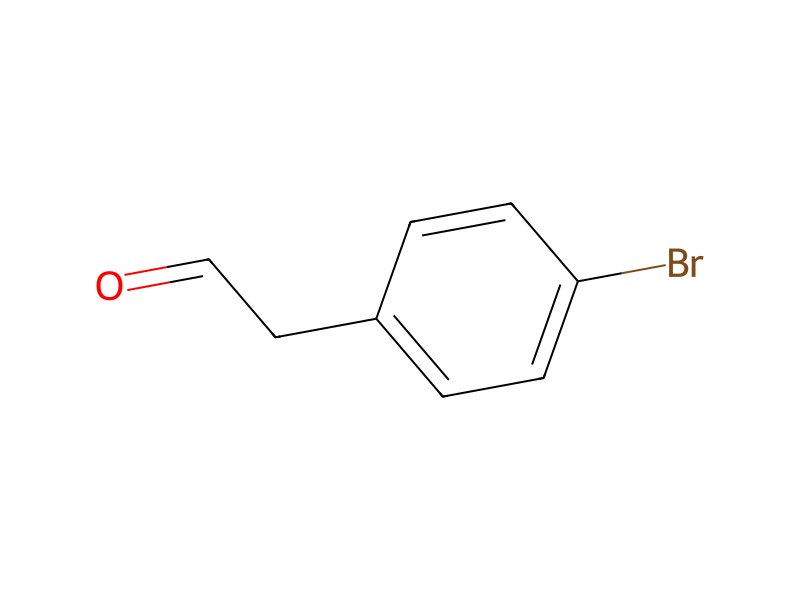
Formaldehyde → 2-(4-Bromophenyl)-2-(hydroxymethyl)propane-1,3-diol
Reaction equation

N#N.[Br:3][C:4]1[CH:9]=[CH:8][C:7]([CH2:10][CH:11]=[O:12])=[CH:6][CH:5]=1.[CH2:13]=[O:14].C1[CH2:19][O:18]CC1>>[Br:3][C:4]1[CH:9]=[CH:8][C:7]([C:10]([CH2:19][OH:18])([CH2:13][OH:14])[CH2:11][OH:12])=[CH:6][CH:5]=1Participants
5



Conditions
- Temperature
- 63 °C
Procedure
To a 50-mL three-neck 14/20 round-bottomed flask equipped with a stir bar, a reflex condenser, a thermometer, and N2 inlet was added samples of 11 (6.00 g, 30.1 mmol), paraformaldehyde (5.90 g, 196 mmol), Ca(OH)2 (1.79 g, 24.2 mmol), and THF (22 mL). The cloudy white mixture was heated to 63° C. and stirred at this temperature for 3 d. The reaction mixture was then cooled and filtered through Celite. The filtrate was concentrated to a viscous, pale yellow oil. The residue was pumped on under high vacuum at 100° C. (to remove volatiles) for 1 h. Column chromatography (silica, EtOAc) afforded a pale yellow viscous oil which was mostly pure by TLC. This oil was used directly in the next step.
Workup
- customTo a 50-mL three-neck 14/20 round-bottomed flask equipped with a stir bar, a reflex condenser
- temperatureThe reaction mixture was then cooled
- filtrationfiltered through Celite
- concentrationThe filtrate was concentrated to a viscous, pale yellow oil
- customwas pumped on under high vacuum at 100° C.
- custom(to remove volatiles) for 1 h
- customColumn chromatography (silica, EtOAc) afforded a pale yellow viscous oil which
Sources & evidence
- ORD record
- ord-8b07b14f9d60498a98499475b4dec4c9
- Source dataset
- uspto-grants-2012_05
- Patent number
- US08173630B2
Reaction notes
Loading…