Acetic Acid → HCID 53392350, compound
Reaction equation

[NH:1]1[C:10]2[C:5](=[CH:6][CH:7]=[CH:8][CH:9]=2)[CH2:4][CH2:3][CH2:2]1.O=[C:12]1[CH2:16][CH2:15][N:14]([C:17]([O:19][C:20]([CH3:23])([CH3:22])[CH3:21])=[O:18])[CH2:13]1.C(O[BH-](OC(=O)C)OC(=O)C)(=O)C.[Na+].C(O)(=O)C>ClCCCl>[N:1]1([CH:16]2[CH2:12][CH2:13][N:14]([C:17]([O:19][C:20]([CH3:23])([CH3:22])[CH3:21])=[O:18])[CH2:15]2)[C:10]2[C:5](=[CH:6][CH:7]=[CH:8][CH:9]=2)[CH2:4][CH2:3][CH2:2]1Participants

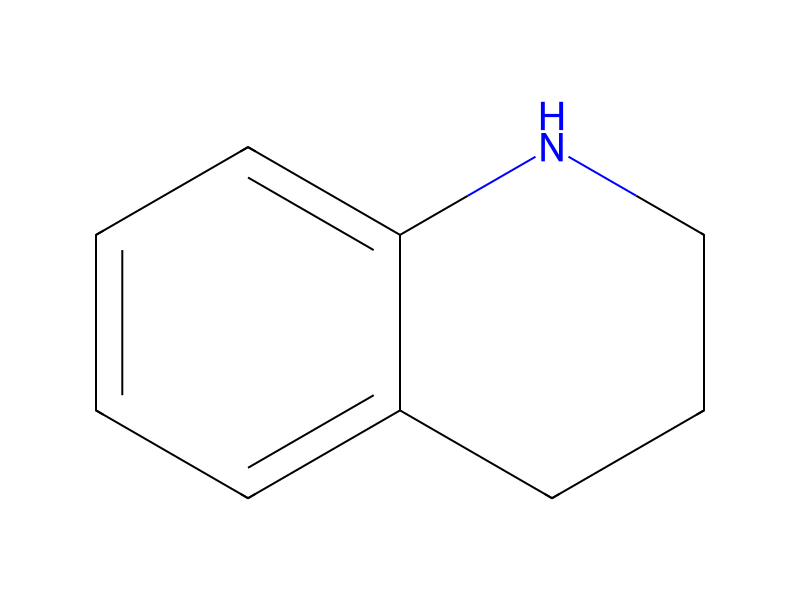




Procedure
A solution of 1,2,3,4-tetrahydroquinoline (1.0 mL, 7.94 mmol) in 30 mL 1,2-dichloroethane was treated with tert-butyl 3-oxopyrrolidine-1-carboxylate (2.94 g, 15.87 mmol) followed by sodium triacetoxyborohydride (8.4 g, 39.68 mmol) then acetic acid (2.25 mL). The suspension was stirred at room temperature for 1 day. After this time, the mixture was cooled to 0° C., quenched with 20 mL 1N NaOH and stirred for 20 minutes. The suspension was extracted with 2×100 mL CH2Cl2. The organic layer was rinsed with brine, dried over MgSO4, filtered and concentrated to give a yellow residue which was subjected to flash chromatography on silica gel using 15% EtOAc/Hexanes to give a viscous oil (1.89 g, 78.8%). 1H-NMR (CDCl3) δ 7.07 (pseudo t, J=7.2 Hz, 1H), 6.97 (d, J=7.2 Hz, 1H), 6.69 (d, J=8.1 Hz, 1H), 6.62 (pseudo t, J=7.5 Hz, 1H), 4.44-4.40 (m, 1H), 3.63-3.20 (m, 6H), 2.75 (t, J=6.3 Hz, 2H), 2.13-2.08 (m, 2H), 1.94-1.90 (m, 2H), 1.48 (s, 9H). MS (ESI): 303.2 (M+1).
Workup
- temperatureAfter this time, the mixture was cooled to 0° C.
- customquenched with 20 mL 1N NaOH
- stirringstirred for 20 minutes
- extractionThe suspension was extracted with 2×100 mL CH2Cl2
- washThe organic layer was rinsed with brine
- dry with materialdried over MgSO4
- filtrationfiltered
- concentrationconcentrated
- customto give a yellow residue which
Sources & evidence
- ORD record
- ord-e703bf132d6140269b8f4f6859562b35
- Source dataset
- uspto-grants-2012_05
- Patent number
- US08173813B2
Reaction notes
Loading…