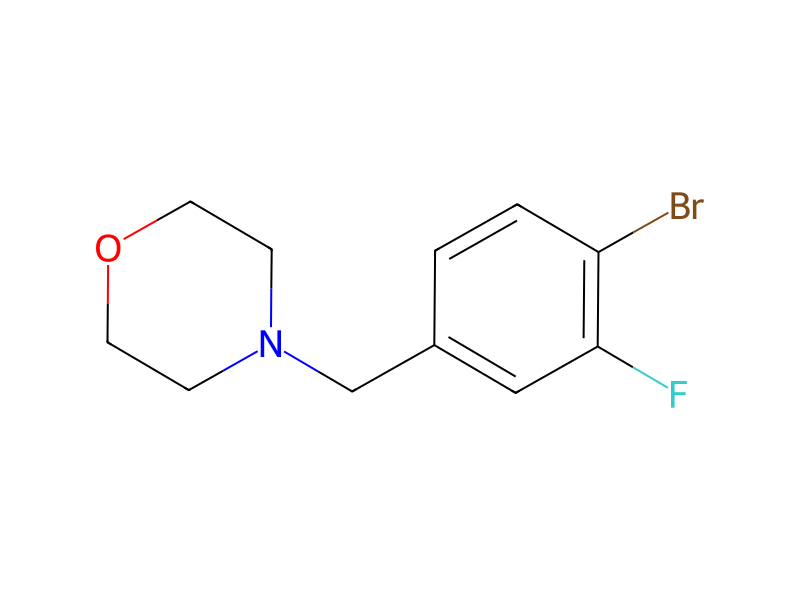
Morpholine → 4-(4-Bromo-3-fluorobenzyl)morpholine
Reaction equation

[Br:1][C:2]1[CH:9]=[CH:8][C:5]([CH:6]=O)=[CH:4][C:3]=1[F:10].[NH:11]1[CH2:16][CH2:15][O:14][CH2:13][CH2:12]1.C(O[BH-](OC(=O)C)OC(=O)C)(=O)C.[Na+].C([O-])(O)=O.[Na+].[OH-].[K+]>ClC(Cl)C.ClCCl.O>[Br:1][C:2]1[CH:9]=[CH:8][C:5]([CH2:6][N:11]2[CH2:16][CH2:15][O:14][CH2:13][CH2:12]2)=[CH:4][C:3]=1[F:10]Participants
Reactant 5





Product 1
Reagents, catalysts & solvents 3



Procedure
4-Bromo-3-fluorobenzaldehyde (4.69 g, 23.10 mmol) was dissolved in degassed dichloroethane (40 mL) and stirred under nitrogen. Morpholine (2.015 mL, 23.10 mmol) was added followed by sodium triacetoxyborohydride (6.37 g, 30.03 mmol) portionwise. The reaction was stirred over night. Saturated NaHCO3 (aq) was added. The phases were separated and the organic phase was washed with 2M HCl (aq). A solid precipitated in the separation funnel. The solid was isolated by filtration. The water phase and the solid were combined and dichloromethane was added. The pH was adjusted to ca 10 by adding solid KOH. The water phase was extracted with dichloromethane (2×) and the organic phase was dried and concentrated to give 4-(4-bromo-3-fluorobenzyl)morpholine (4.45 g, 70%) as a solid.
Workup
- stirringThe reaction was stirred over night
- customThe phases were separated
- washthe organic phase was washed with 2M HCl (aq)
- customA solid precipitated in the separation funnel
- customThe solid was isolated by filtration
- extractionThe water phase was extracted with dichloromethane (2×)
- customthe organic phase was dried
- concentrationconcentrated
Sources & evidence
- ORD record
- ord-19a6db1e9e2c4125a9356428876ea19f
- Source dataset
- uspto-grants-2012_05
- Patent number
- US08178529B2
Reaction notes
Loading…