Water → 2-Methylpyridin-3-ol
Reaction equation

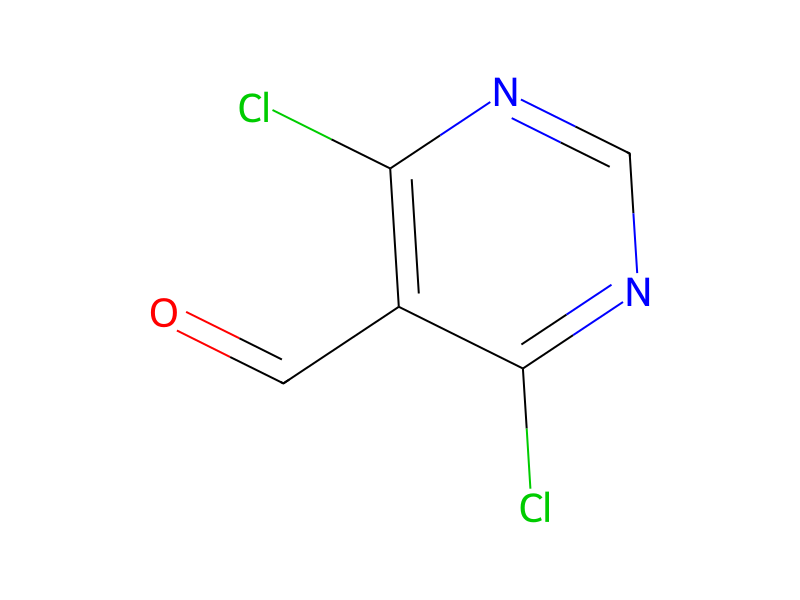
C(=O)([O-])[O-].[K+].[K+].Cl[C:8]1[C:13]([CH:14]=[O:15])=[C:12]([Cl:16])[N:11]=[CH:10][N:9]=1.[OH:17][C:18]1[C:19]([CH3:24])=[N:20][CH:21]=[CH:22][CH:23]=1.O>CN(C)C=O>[OH:17][C:18]1[C:19]([CH3:24])=[N:20][CH:21]=[CH:22][CH:23]=1.[Cl:16][C:12]1[C:13]([CH:14]=[O:15])=[C:8]([O:17][C:18]2[C:19]([CH3:24])=[N:20][CH:21]=[CH:22][CH:23]=2)[N:9]=[CH:10][N:11]=1Participants





Procedure
Potassium carbonate (10.22 g, 74 mmol) was added to a mixture of 4,6-dichloro-pyrimidine-5-carbaldehyde (Intermediate 16; 5.0 g, 28.3 mmol) and 3-hydroxy-2-methylpyridine (Aldrich Chemical Company, Inc., Milwaukee, Wis., USA 3.66 g, 33.5 mmol) in anhydrous dimethylformamide (100 mL). The mixture was stirred at room temperature. The mixture was cooled to 0° C. and water (100 mL) was slowly added. The temperature rose to 18° C. during the addition. The mixture was recooled to 0° C. and stored in the freezer overnight. The precipitate was filtered off. LC-MS indicated that this was the result of the addition of two 3-hydroxy-2-methylpyridine moieties to the pyrimidine. The mother liquor was extracted with ethyl acetate and the extract was concentrated and purified using a Supelco 100 g column, eluting with 0-5% methanol/dichloromethane. Fractions containing the desired product were pooled, concentrated, and held under vacuum to give 4-chloro-6-(2-methyl-pyridin-3-yloxy)-pyrimidine-5-carbaldehyde (521 mg, 7%) as a solid. 1H NMR (300 MHz, DMSO-d6) δ 2.32 (s, 3H), 7.36 (dd, 1H, J=4.8, 8.2 Hz), 7.66 (dd, 1H, J=1.2, 8.2 Hz), 7.8.41 (dd, 1H, J=1.5, 4.8 Hz), 8.72 (s, 1H).
Workup
- temperatureThe mixture was cooled to 0° C.
- additionThe temperature rose to 18° C. during the addition
- customwas recooled to 0° C.
- customstored in the freezer overnight
- filtrationThe precipitate was filtered off
Sources & evidence
- ORD record
- ord-23b5490e86e24bb89797d0111514aee4
- Source dataset
- uspto-grants-2012_05
- Patent number
- US08188098B2
Reaction notes
Loading…