Hydrogen Peroxide → 4-Pyridinecarbonitrile, 1-oxide
Reaction equation

[C:1]([C:3]1[CH:8]=[CH:7][N:6]=[CH:5][CH:4]=1)#[N:2].[OH:9]O>CO>[C:1]([C:3]1[CH:8]=[CH:7][N+:6]([O-:9])=[CH:5][CH:4]=1)#[N:2]Participants
Reactant 2

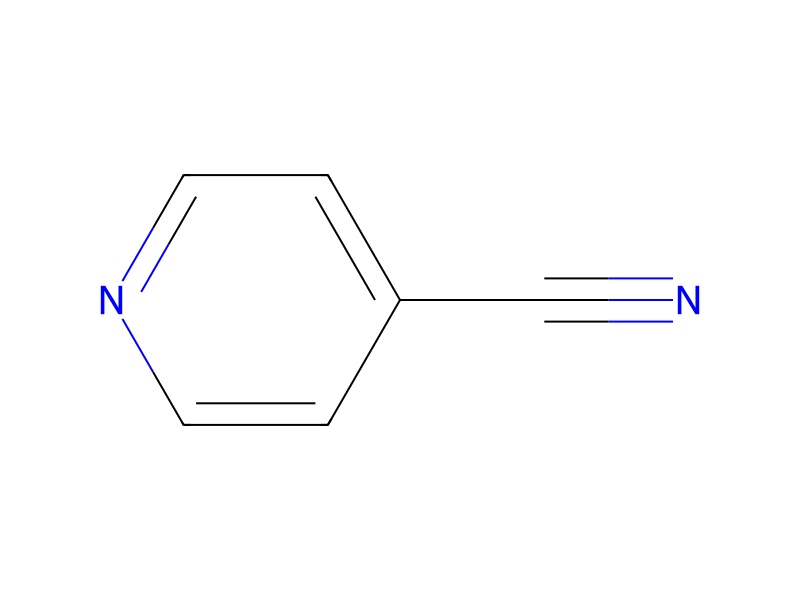
Product 1

Reagents, catalysts & solvents 1

Procedure
This example illustrates the use of catalytic activity of the product obtained in Example 1. A typical oxidation of substituted pyridine to substituted pyridine N-oxide was carried out as follows. 0.5 g. of the material obtained according to example 1, (x=0.064) were added to a mixture containing 10.0 g 4-Cyano pyridine and 40 ml methanol under stirring. The temperature of this reaction mixture was kept at 60° C. and then 19.8 g. of H2O2 (30%) were added drop wise to the reaction mixture under stirring. The progress of the reaction followed by Thin Layer Chromatography. Then this reaction was carried out for 24 hours. Once the reaction was complete the catalyst was removed by filtration and the solvent was distilled off under vacuum. The isolated product by this procedure contained, exclusively the corresponding N-oxide is observed from the 1HNMR and mass spectra. 4-Cyanopyridne gave 9.6 g of coresponding 4-Cyanopyridine N-oxide without any trace of byproduct.
Workup
- customof the material obtained
- additionwere added to a mixture
- customwas kept at 60° C.
- stirringunder stirring
- customwas removed by filtration
- distillationthe solvent was distilled off under vacuum
Sources & evidence
- ORD record
- ord-15699163bdbc4cc085b10ba701d1cd04
- Source dataset
- uspto-grants-2002_05
- Patent number
- US06387349B1
Reaction notes
Loading…