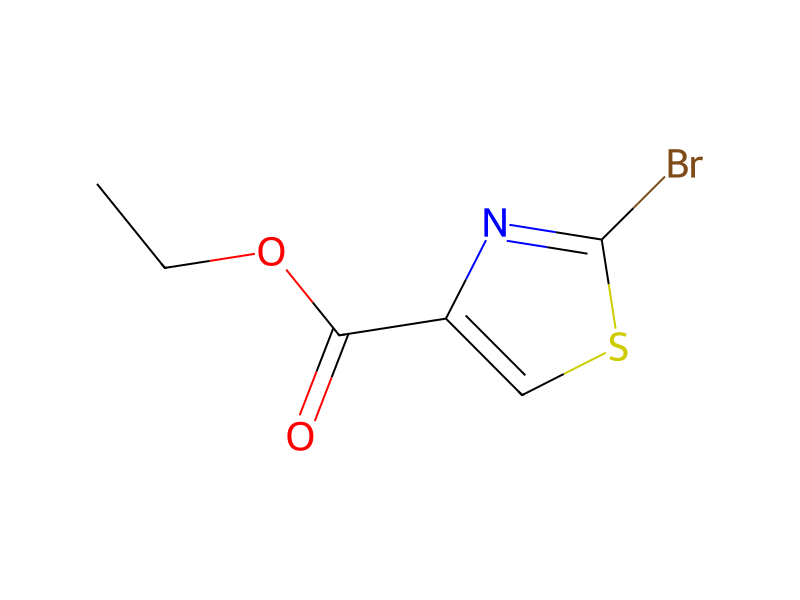
Hydrogen Bromide → Ethyl 2-bromo-1,3-thiazole-4-carboxylate
Reaction equation

[CH2:1]([O:3][C:4]([C:6]1[N:7]=[C:8](N)[S:9][CH:10]=1)=[O:5])[CH3:2].N([O-])=O.[Na+].[BrH:16]>O>[CH2:1]([O:3][C:4]([C:6]1[N:7]=[C:8]([Br:16])[S:9][CH:10]=1)=[O:5])[CH3:2]Participants
5
Reactant 3



Product 1
Reagents, catalysts & solvents 1

Conditions
- Temperature
- -15 °C
Procedure
A solution of 30 g (174.3 mmol) ethyl-2-aminothiazole-4-carboxylate [prepared as in Example 1a)] in a mixture of 100 ml HBr (65%) and 100 ml of water was cooled to -15° C. and a solution of 12.03 g (174.3 mmol) sodium nitrite in 40 ml water was added over a period of 30 minutes and the mixture stirred for another 30 minutes at -15° C. After warming to room temperature, the solid was collected, washed with 50 ml cold water and dried to give 23.7 g (57.6%) ethyl-2-bromothiazole-4-carboxylate m.p. 63°-65° C.
Workup
- temperatureAfter warming to room temperature
- customthe solid was collected
- washwashed with 50 ml cold water
- customdried
Sources & evidence
- ORD record
- ord-a477c547d44145c68efc504b379d6707
- Source dataset
- uspto-grants-1997_12
- Patent number
- US05693594
Reaction notes
Loading…