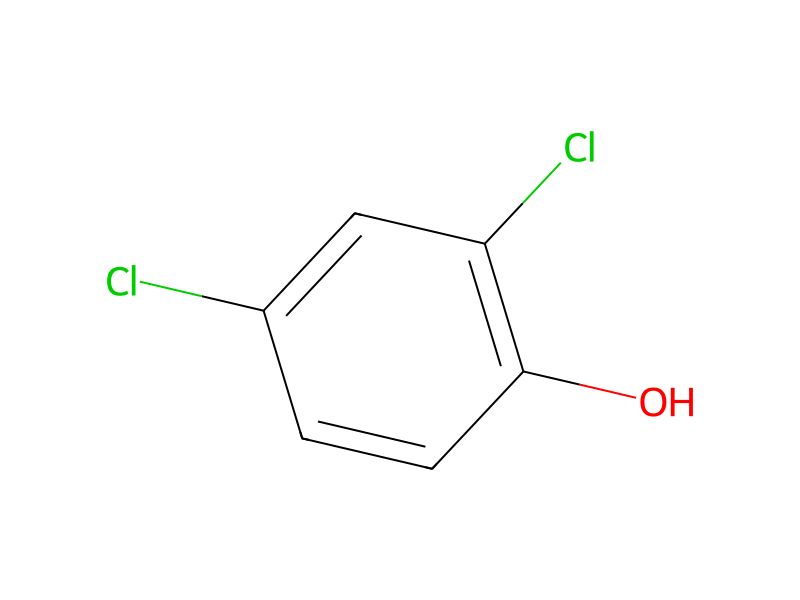
2,4-Dichlorophenol → (2,4-Dichlorophenoxy)propanol
Reaction equation

Br[CH2:2][CH2:3][CH2:4][OH:5].[Cl:6][C:7]1[CH:12]=[C:11]([Cl:13])[CH:10]=[CH:9][C:8]=1[OH:14].N12CCCN=C1CCCCC2>C(O)(C)C.C(Cl)Cl>[Cl:6][C:7]1[CH:12]=[C:11]([Cl:13])[CH:10]=[CH:9][C:8]=1[O:14][CH2:2][CH2:3][CH2:4][OH:5]Participants
6





Procedure
A solution of 3-bromopropanol (53.86 g, 0.368 mol) in isopropanol is added dropwise to a mixture of 2,4-dichlorophenol (50 g, 0.307 mol) and 1,8-diazabicyclo[5.4.0]undec-7-ene (70.05 g, 0.406 mol) in isopropanol at reflux. The reaction mixture is heated at reflux for 3 hours and concentrated in vacuo to obtain a residue. The residue is dissolved in methylene chloride and the organic solution is washed sequentially with 0.5N sodium hydroxide solution, 1M hydrochloric acid and brine, dried over MgSO4 and concentrated in vacuo to obtain an oil which solidifies to give the title product as a white solid (71.9 g, mp 53°-55° C.).
Workup
- temperatureat reflux
- temperatureThe reaction mixture is heated
- temperatureat reflux for 3 hours
- concentrationconcentrated in vacuo
- customto obtain a residue
- washthe organic solution is washed sequentially with 0.5N sodium hydroxide solution, 1M hydrochloric acid and brine
- dry with materialdried over MgSO4
- concentrationconcentrated in vacuo
- customto obtain an oil which
Sources & evidence
- ORD record
- ord-de05edcca3cf4b73852ddb71d1874a57
- Source dataset
- uspto-grants-1997_12
- Patent number
- US05696050
Reaction notes
Loading…