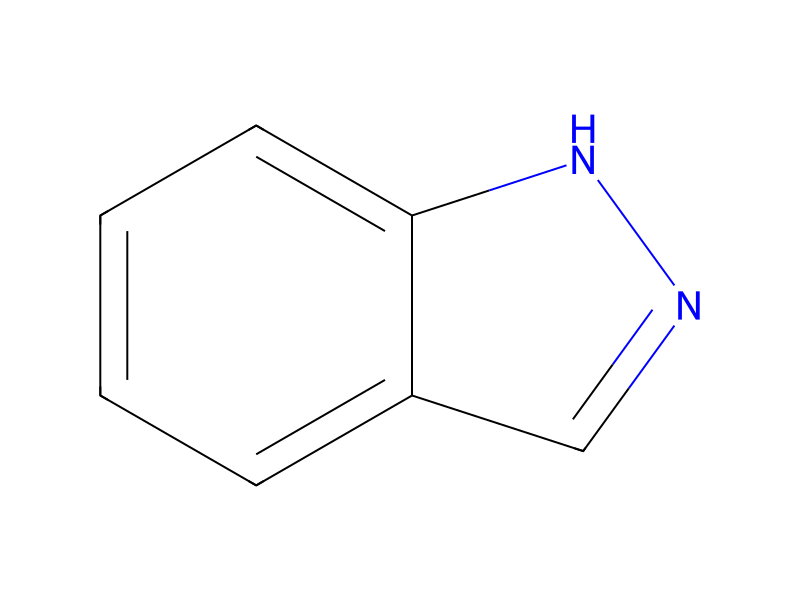
1H-Indazole → HCID 54413098, compound
Reaction equation

I[C:2]1[C:11](=[O:12])[C:10]2[C:5](=[CH:6][CH:7]=[CH:8][CH:9]=2)[O:4][CH:3]=1.[NH:13]1[C:21]2[C:16](=[CH:17][CH:18]=[CH:19][CH:20]=2)[CH:15]=[N:14]1.C(=O)([O-])[O-].[K+].[K+]>CN(C)C=O>[NH:13]1[C:21]2[C:16](=[CH:17][CH:18]=[CH:19][CH:20]=2)[C:15]([C:3]2[O:4][C:5]3[C:10]([C:11](=[O:12])[CH:2]=2)=[CH:9][CH:8]=[CH:7][CH:6]=3)=[N:14]1Participants
Reactant 3


Product 1

Reagents, catalysts & solvents 1

Procedure
To an eggplant type flask (25 ml), 3-iodochromone (136 mg) prepared in Example 1, indazole (236 mg), potassium carbonate (1382 mg), and dimethylformamide (15 mg) were added and the mixture was reacted at 80° C. for 30 hours with stirring. The reaction mixture was added to ice water and extracted with chloroform. The organic layer was dried over anhydrous sodium sulfate, and concentrated under reduced pressure. The residue was purifiedby the silica gel column chromatography, and the purified product was recrystallized from benzene/hexane to give the titled compound (113.6 mg; yield=88.5%) as crystals. Melting point: 237°-238° C. 1H-NMR(CDCl3, δ ppm): 6.94 (s, H3), 8.26 (dd, H5), 7.58-7.68 (m, H6), 7.75 (t, H7), 7.58-7.68 (m, H8), 8.30 (s, H3'), 7.82 (m, H4'), 7.35-7.53 (m, H5'), 7.35-7.53 (m, H6'), 8.26 (m, H7') .
Workup
- customthe mixture was reacted at 80° C. for 30 hours
- extractionextracted with chloroform
- dry with materialThe organic layer was dried over anhydrous sodium sulfate
- concentrationconcentrated under reduced pressure
- customthe purified product was recrystallized from benzene/hexane
Sources & evidence
- ORD record
- ord-cb22f5da32ab4e8e817ca5cda0b0e551
- Source dataset
- uspto-grants-1997_12
- Patent number
- US05698575
Reaction notes
Loading…