3,4-dihydro-2H-pyran → 4-Bromo-2-t-butyl-1-(2-tetrahydropyranoxy)benzene
Reaction equation

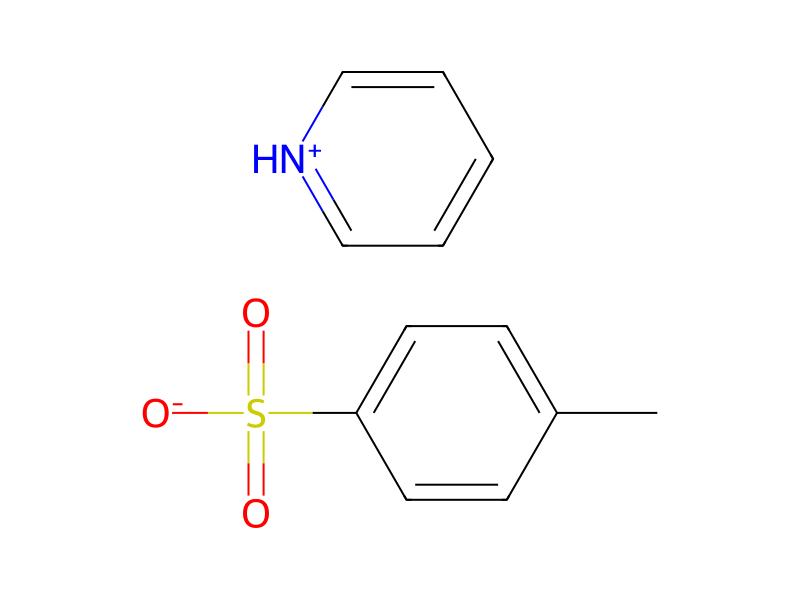
[Br:1][C:2]1[CH:7]=[CH:6][C:5]([OH:8])=[C:4]([C:9]([CH3:12])([CH3:11])[CH3:10])[CH:3]=1.[O:13]1[CH:18]=[CH:17][CH2:16][CH2:15][CH2:14]1.C1(C)C=CC(S([O-])(=O)=O)=CC=1.[NH+]1C=CC=CC=1>ClCCl>[Br:1][C:2]1[CH:7]=[CH:6][C:5]([O:8][CH:14]2[CH2:15][CH2:16][CH2:17][CH2:18][O:13]2)=[C:4]([C:9]([CH3:12])([CH3:11])[CH3:10])[CH:3]=1Participants




Procedure
To a solution of 18.92 g (82.6 mmol) of 4-bromo-2-t-butylphenol (Compound E) in 110 ml of dichloromethane was added dropwise 10.42 g (11.3 ml, 123.9 mmol) of 3,4-dihydro-2H-pyran. To this clear, colorless solution was added 1.86 g (7.4 mmol) of pyridinium p-toluenesulfonate. The resulting mixture was stirred at room temperature under a blanket of argon for 26.5 hours, partitioned between 250 ml of water and 400 ml of hexane, and the layers were separated. The organic phase was washed with 2×250 ml-portions of water and 150 ml of brine solution, dried over MgSO4, filtered and concentrated in vacuo to a yellow oil. Purification by flash chromatography (silica, 5% ethyl acetate in hexane) yielded the title compound as a light yellow, crystalline solid. PMR (CDCl3): d 1.39 (9H, s), 1.6-2.1 (6H, m), 3.6-3.7 (1H, m), 3.8-3.9 (1H, m), 5.43 (1H, t, J=2.7 Hz), 7.06 (1H, d, J=8.8 Hz), 7.24 (1H, dd, J=8.8, 2.7 Hz), 7.36 (1H, d, J=2.7 Hz).
Workup
- custompartitioned between 250 ml of water and 400 ml of hexane
- customthe layers were separated
- washThe organic phase was washed with 2×250 ml-portions of water and 150 ml of brine solution
- dry with materialdried over MgSO4
- filtrationfiltered
- concentrationconcentrated in vacuo to a yellow oil
- customPurification by flash chromatography (silica, 5% ethyl acetate in hexane)
Sources & evidence
- ORD record
- ord-052efa6210a14717b5a67496e60dcbe2
- Source dataset
- uspto-grants-1997_12
- Patent number
- US05698700
Reaction notes
Loading…