3,4-dihydro-2H-pyran → 2-(1-Adamantyl)-4-bromo-1-(2-tetrahydropyranoxy)benzene
Reaction equation

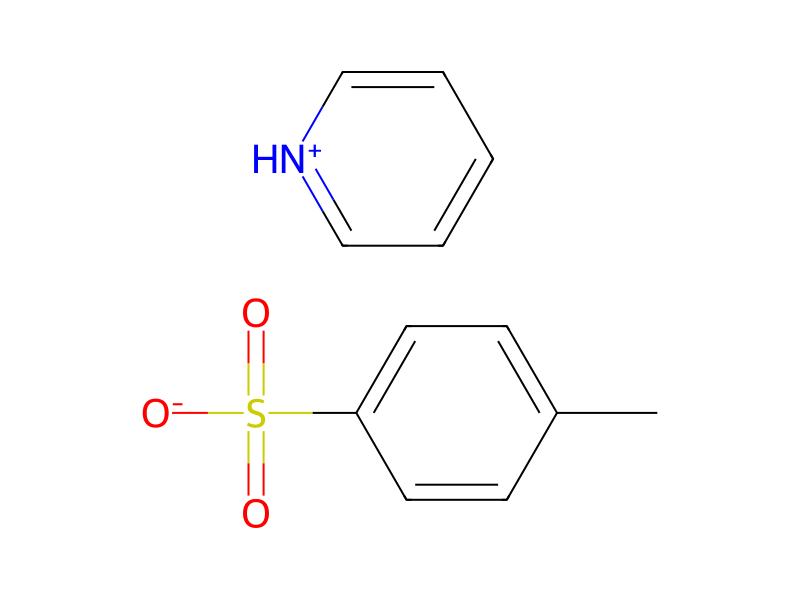
[CH2:1]([C:5]1[CH:10]=[CH:9][CH:8]=[CH:7][C:6]=1[O:11][CH:12]1[CH2:17][CH2:16][CH2:15][CH2:14][O:13]1)[CH2:2][CH2:3][CH3:4].C12(C3C=CC([Br:34])=CC=3O)CC3CC(CC(C3)C1)C2.[C:36]1([CH3:46])[CH:41]=C[C:39](S([O-])(=O)=O)=[CH:38][CH:37]=1.[NH+]1C=CC=CC=1.O1C=CCCC1>ClCCl>[C:1]12([C:5]3[CH:10]=[C:9]([Br:34])[CH:8]=[CH:7][C:6]=3[O:11][CH:12]3[CH2:17][CH2:16][CH2:15][CH2:14][O:13]3)[CH2:39][CH:38]3[CH2:37][CH:36]([CH2:46][CH:3]([CH2:4]3)[CH2:2]1)[CH2:41]2Participants
6
Reactant 4



Product 1

Reagents, catalysts & solvents 1

Procedure
Using the same general procedure as for the preparation of of 4-bromo-2-| -butyl-1-(2-tetrahydropyranoxy)benzene (Compound H), but instead using 9.17 g (29.9 mmol) of 2-(1-adamantyl)-4-bromophenol (Compound F), 0.75 g (3.0 mmol) of pyridinium p-toluenesulfonate, 3.77 g (4.1 ml, 44.8 mmol) of 3,4-dihydro-2H-pyran and 50 ml of dichloromethane produced a bright yellow solid. Purification by flash chromatography (preabsorbed onto silica with chloroform, eluted with 2% ethyl acetate in hexane) yielded the title compound as a nearly white solid. PMR (CDCl3): d 1.6-2.2 (21H, m), 3.6-3.7 (1H, m), 3.8-3.9 (1H, m), 5.43 (1H, t, J=2.4 Hz), 7.05 (1H, d, J=8.7 Hz), 7.23 (1H, dd, J=8.7, 2.5 Hz), 7.30 (1H, d, J=2.5 Hz).
Workup
- customproduced a bright yellow solid
- customPurification
- customby flash chromatography (preabsorbed onto silica with chloroform, eluted with 2% ethyl acetate in hexane)
Sources & evidence
- ORD record
- ord-fc0ff829179b4344890f43363c796770
- Source dataset
- uspto-grants-1997_12
- Patent number
- US05698700
Reaction notes
Loading…