Ethyl trifluoroacetate → 3-Trifluoroacetyl-3-cyanopropionaldehyde diethyl acetal
Reaction equation

[H-].[Na+].[F:3][C:4]([F:11])([F:10])[C:5](OCC)=[O:6].[CH2:12]([O:14][CH:15]([O:20][CH2:21][CH3:22])[CH2:16][CH2:17][C:18]#[N:19])[CH3:13]>O1CCCC1>[CH2:21]([O:20][CH:15]([O:14][CH2:12][CH3:13])[CH2:16][CH:17]([C:5](=[O:6])[C:4]([F:11])([F:10])[F:3])[C:18]#[N:19])[CH3:22]Participants
Reactant 3
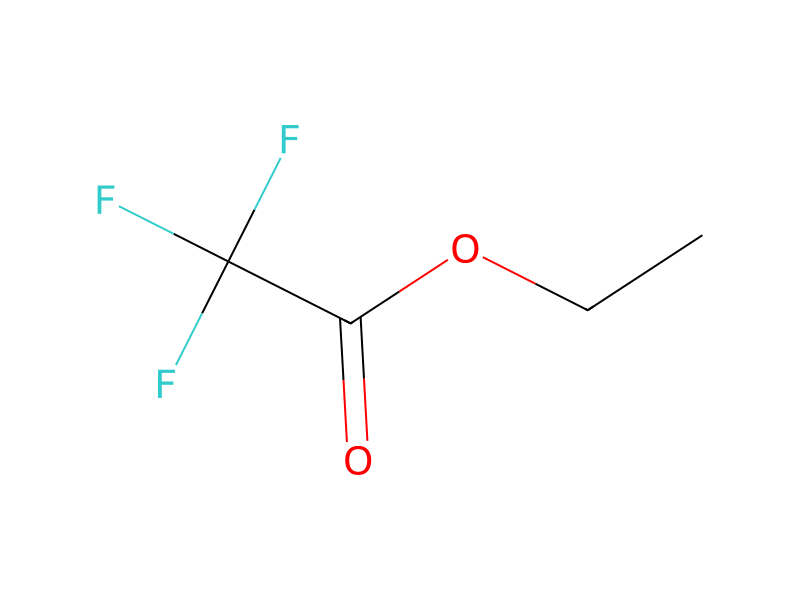


Product 1

Reagents, catalysts & solvents 1

Procedure
Preparation of (trifluoromethyl)pyrrole carbonitriles and conversion thereof to dihalo (trifluoromethyl)pyrrole carbonitriles and dihalo- alkylated N-(trifluoromethyl)pyrrole carbonitriles can be achieved by the admixture of a dispersion of sodium hydride in tetrahydrofuran with a solution of ethyl trifluoroacetate and 3-cyano propionaldehyde diethyl acetal in tetrahydrofuran. The reaction that occurs yields 3-trifluoroacetyl-3-cyanopropionaldehyde diethyl acetal which is then heated with oxalic acid dihydrate in water to give the 3-trifluoroacetyl-3-cyanopropionaldehyde. The thus prepared aldehyde is then dissolved in glacial acetic acid and the resulting solution treated with ammonium acetate to provide the 2-(trifluoromethyl)pyrrole-3-carbonitrile. Halogenation of the above-said (trifluoromethyl)pyrrole carbonitrile may then be accomplished by reaction of said (trifluoromethyl)pyrrole carbonitrile with N-bromosuccinimide or N-chlorosuccinimide in the presence of tetrahydrofuran to yield the dihalo (trifluoromethyl)pyrrole carbonitrile. Alkylation or acylation of this dihalo (trifluoromethyl)pyrrole carbonitrile with an alkyl halide or acylhalide in the presence of potassium t-butoxide and tetrahydrofuran yields the N-alkylated (or N-acylated) dihalo (trifluoromethyl)pyrrole carbonitrile.
Workup
- customThe reaction
Sources & evidence
- ORD record
- ord-f4a2ff6fb6da41c28edb4d902b90d1a6
- Source dataset
- uspto-grants-1997_12
- Patent number
- US05702681
Reaction notes
Loading…