Formaldehyde → 3-[4-(Methyl-phenethyl-amino)-phenyl]-propionic acid ethyl ester
Reaction equation

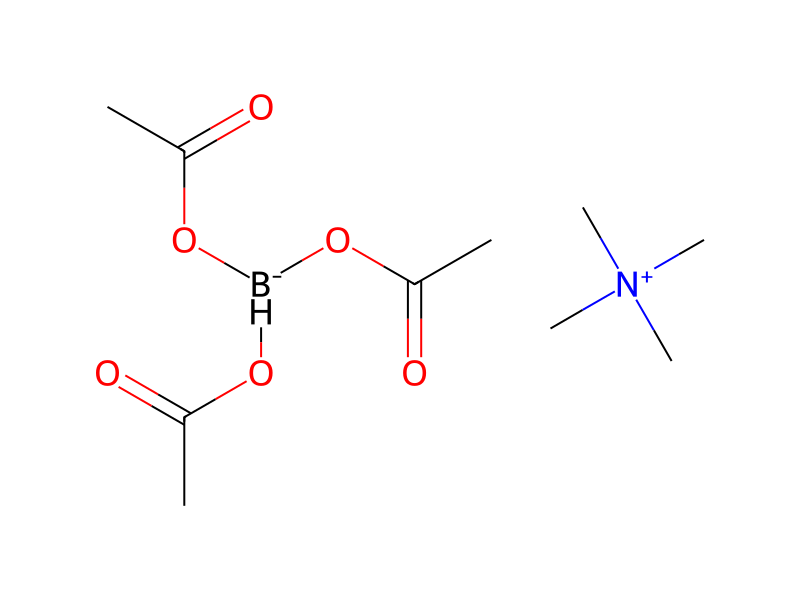
C=O.[CH2:3]([O:5][C:6](=[O:24])[CH2:7][CH2:8][C:9]1[CH:14]=[CH:13][C:12]([NH:15][CH2:16][CH2:17][C:18]2[CH:23]=[CH:22][CH:21]=[CH:20][CH:19]=2)=[CH:11][CH:10]=1)[CH3:4].[C:25](O[BH-](OC(=O)C)OC(=O)C)(=O)C.C[N+](C)(C)C.[OH-].[NH4+]>ClCCCl>[CH2:3]([O:5][C:6](=[O:24])[CH2:7][CH2:8][C:9]1[CH:14]=[CH:13][C:12]([N:15]([CH3:25])[CH2:16][CH2:17][C:18]2[CH:23]=[CH:22][CH:21]=[CH:20][CH:19]=2)=[CH:11][CH:10]=1)[CH3:4]Participants
Reactant 4



Product 1

Reagents, catalysts & solvents 1

Procedure
Paraformaldehyde (0.89 g, 30.5 mmol) was added to a solution of 3-[4-(Phenethyl-amino)-phenyl]-propionic acid ethyl ester (1.3 g, 4.37 mmol) in 1,2-dichloroethane (25 mL). The resultant suspension was stirred at room temperature for 15 minutes. Tetramethylammonium triacetoxyborohydride (2.0 g, 8.74 mmol) was added, and the suspension was heated at reflux for 6 hours. The mixture was cooled to room temperature and treated with ammonium hydroxide (20 mL). The organic layer was separated and applied to a silica gel column. The product was eluted with ethyl acetate/hexane (1/20) to give an oil, 0.80 g (59%). MS: m/z 312 (MH+). 1H NMR (CDCl3): δ 1.23 (t, 3 H), 2.55 (t, 2 H), 2.90 (t, 2 H), 3.37 (t, 2 H), 3.59 (br s, 1 H), 4.11 (q, 2 H), 6.55 (d, 2 H), 7.01 (d, 2 H), 7.20-7.37 (m, 5 H).
Workup
- temperaturethe suspension was heated
- temperatureat reflux for 6 hours
- customThe organic layer was separated
- washThe product was eluted with ethyl acetate/hexane (1/20)
- customto give an oil, 0.80 g (59%)
Sources & evidence
- ORD record
- ord-747827870a8f40e5ad5229dd6114b546
- Source dataset
- uspto-grants-2013_03
- Patent number
- US08394828B2
Reaction notes
Loading…