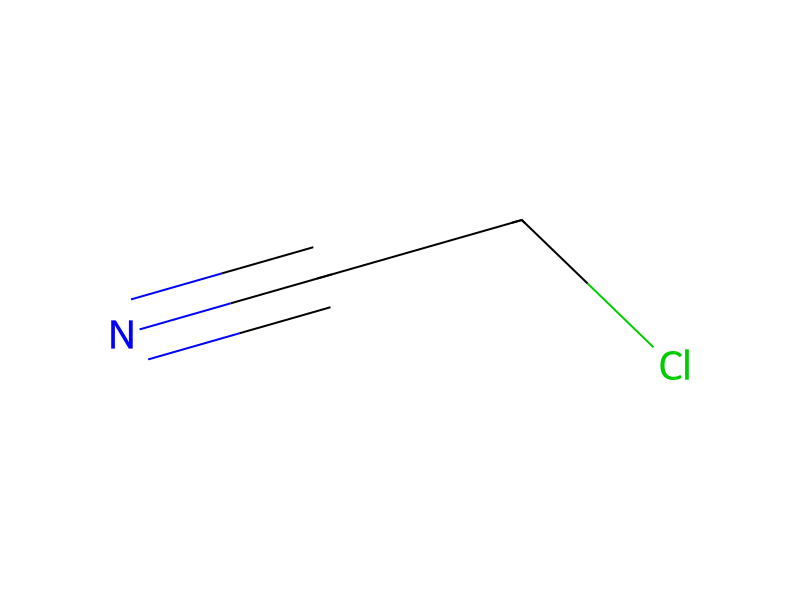
Chloroacetonitrile → HCID 10411719, compound
Reaction equation

[Cl:1][C:2]1[C:3]([F:29])=[C:4]([CH:26]=[CH:27][CH:28]=1)[NH:5][C:6]1[C:15]2[C:10](=[CH:11][C:12]([O:24][CH3:25])=[C:13]([O:16][CH2:17][CH:18]3[CH2:23][CH2:22][NH:21][CH2:20][CH2:19]3)[CH:14]=2)[N:9]=[CH:8][N:7]=1.C(=O)([O-])[O-].[K+].[K+].Cl[CH2:37][C:38]#[N:39]>CC(N(C)C)=O>[Cl:1][C:2]1[C:3]([F:29])=[C:4]([CH:26]=[CH:27][CH:28]=1)[NH:5][C:6]1[C:15]2[C:10](=[CH:11][C:12]([O:24][CH3:25])=[C:13]([O:16][CH2:17][CH:18]3[CH2:23][CH2:22][N:21]([CH2:37][C:38]#[N:39])[CH2:20][CH2:19]3)[CH:14]=2)[N:9]=[CH:8][N:7]=1Participants
Reactant 3


Product 1

Reagents, catalysts & solvents 1

Conditions
- Temperature
- 60 °C
Procedure
4-(3-Chloro-2-fluoroanilino)-7-methoxy-6-[(piperidin-4-yl)methoxy]quinazoline (Example 3, 104 mg, 0.25 mmol) was dissolved in DMA (5 ml). Potassium carbonate (138 mg, 1.00 mmol) and chloroacetonitrile (17 μl, 0.25 mmol) were added. The mixture was stirred at 60° C. for 4 hours. Further potassium carbonate (138 mg, 1.00 mmol) and chloroacetortitrile (17 μl, 0.25 mmol) were added, and heating was continued at 60° C. for a further 4 hours. The solvent was evaporated and the residue was partitioned between DCM (20 ml) and water (20 ml). The aqueous layer was extracted with DCM (2×10 ml) and the extractions combined with the DCM layer. The combined DCM fractions were filtered through a silicone-treated filter paper and evaporated. The residue was purified by chromatography, eluting with 0 to 2% (7:1 MeOH/concentrated aqueous NH4OH) in DCM. The appropriate fractions were combined and evaporated. The residue was further purified using reverse phase HPLC, eluting with 5 to 95% acetonitrile in water containing 0.2% trifluoroacetic acid. The appropriate fractions were combined; the acetonitrile was evaporated from the solution, and the resulting aqueous solution was adjusted to pH 8 using concentrated aqueous ammonia. The resulting suspension was extracted twice with DCM, and the extractions combined, filtered through a silicone-treated filter paper, and evaporated. The residue was triturated with diethyl ether to give the product as a white solid (10 mg, 9%); 1H NMR: 132-1.46 (m, 2H), 1.75-1.92 (m, 3H), 220 (m, 2H), 2.84 (m, 2H), 3.72 (s, 2H), 3.93 (s, 3H), 3.98 (d, 2H), 7.20 (s, 1H), 7.26 (dd, 1H), 7.47 (dd, 1H), 7.50 (dd, 1H), 7.76 (s, 1H), 8.36 (s, 1H), 9.59 (s, 1H); Mass Spectrum; 456.4, 458.4
Workup
- temperatureheating
- waitwas continued at 60° C. for a further 4 hours
- customThe solvent was evaporated
- customthe residue was partitioned between DCM (20 ml) and water (20 ml)
- extractionThe aqueous layer was extracted with DCM (2×10 ml)
- extractionthe extractions
- filtrationThe combined DCM fractions were filtered through a silicone-
- additiontreated
- filtrationfilter paper
- customevaporated
- customThe residue was purified by chromatography
- washeluting with 0 to 2% (7:1 MeOH/concentrated aqueous NH4OH) in DCM
- customevaporated
- customThe residue was further purified
- washeluting with 5 to 95% acetonitrile in water containing 0.2% trifluoroacetic acid
- customthe acetonitrile was evaporated from the solution
- extractionThe resulting suspension was extracted twice with DCM
- extractionthe extractions
- filtrationfiltered through a silicone-
- additiontreated
- filtrationfilter paper
- customevaporated
- customThe residue was triturated with diethyl ether
Sources & evidence
- ORD record
- ord-8b7309e679814a5b89eb499a90c8228b
- Source dataset
- uspto-grants-2013_03
- Patent number
- US08399667B2
Reaction notes
Loading…