Hydrochloric Acid → (2R,3S,4S,5R)-2,3,4,5,6-pentahydroxyhexanal
Reaction equation

CC1OC(CO)C(O)C([O:11][CH:12]2[O:17][CH:16]([CH2:18][O:19]C3OCC(O)C(OC)C3O)[CH:15]([OH:30])[CH:14]([O:31]C)[CH:13]2[OH:33])C1O.Cl>O>[O:11]=[CH:12][C@@H:13]([C@H:14]([C@H:15]([C@@H:16]([CH2:18][OH:19])[OH:17])[OH:30])[OH:31])[OH:33]Participants
Reactant 2


Product 1
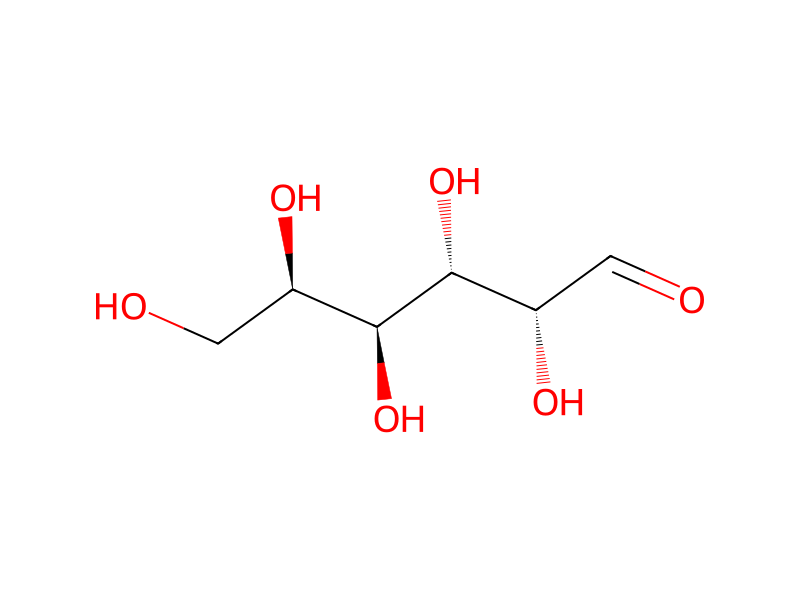
Reagents, catalysts & solvents 1

Conditions
- Temperature
- 20 °C
Procedure
500 kg of galactoarabinan (e.g. FiberAid®) are dissolved or suspended in 4,000-5,000 l of water. The pH is adjusted using approximately 50-60 l hydrochloric acid (30% by weight) to a value in the range from 1.0-1.5. The temperature is adjusted to 100° C. The hydrolysis is carried out for 24 hours (hydrolysis control by means of HPLC). Once the hydrolysis is complete cooling takes place to 50-60° C., with filtration (for example by means of a chamber filter press, for example with the Hyflo filter aid) and neutralization, with the solution or the suspension being passed over an alkaline ion exchanger and then again over an acid ion exchanger and then again over an alkaline ion exchanger. The ion exchangers are rinsed with approximately 2,000 l town water. Then the solution or suspension is concentrated by distillation (to approximately 1,500 l) and made to crystallize. The raw ingredient is centrifuged. 500 l 90% by weight of ethanol (remainder: water) are added to the raw product and agitated for one hour at a temperature of approximately 20° C. Through filtration (for example in a chamber filter press) the flushing liquor is separated from the solid matter. This process is carried out twice. The D-galactose raw product is dissolved for recrystallization (100° C., water, saturated solution), active charcoal is added and then filtration performed, for example via the Hyflo filter aid. From the filtrate the D-galactose can be crystallized again and then centrifuged. If necessary, for further purification, recrystallization can be performed again (saturated solution crystallization). Next, the D-galactose obtained in this way is dried (for example by circulating air or vacuum drying cabinet) and ground to the desired particle size.
Workup
- customis adjusted to 100° C
- custom(hydrolysis control by means of HPLC)
- temperatureOnce the hydrolysis is complete cooling
- customto 50-60° C.
- filtrationwith filtration (for example by means of a chamber
- filtrationfilter press
- washThe ion exchangers are rinsed with approximately 2,000 l town water
- concentrationThen the solution or suspension is concentrated by distillation (to approximately 1,500 l)
- customto crystallize
- addition500 l 90% by weight of ethanol (remainder: water) are added to the raw product
- filtrationThrough filtration (for example in a chamber
- filtrationfilter press) the flushing liquor
- customis separated from the solid matter
- dissolutionThe D-galactose raw product is dissolved for recrystallization (100° C., water, saturated solution), active charcoal
- additionis added
- filtrationfiltration
- filtrationfilter aid
- customFrom the filtrate the D-galactose can be crystallized again
- customIf necessary, for further purification, recrystallization
- custom(saturated solution crystallization)
Sources & evidence
- ORD record
- ord-593063820edb4017b9279e7265a59ced
- Source dataset
- uspto-grants-2013_03
- Patent number
- US08404835B2
Reaction notes
Loading…