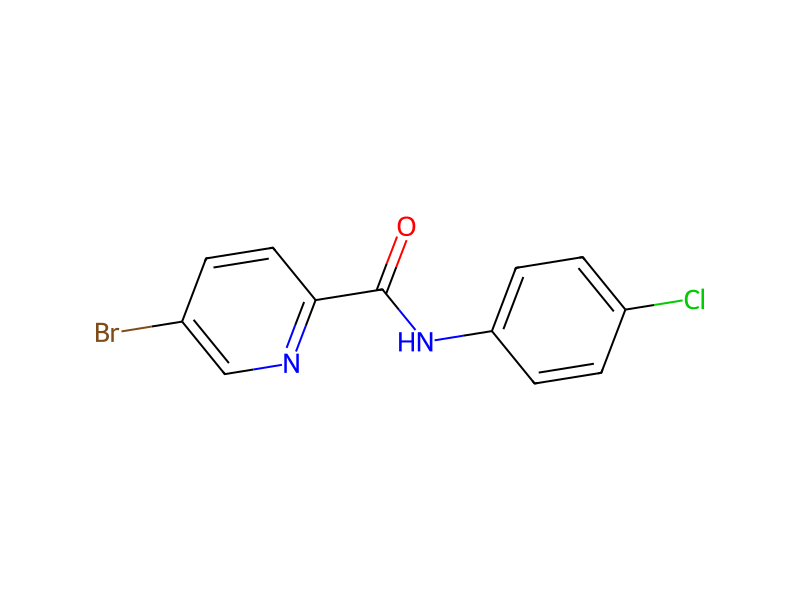
Hydrochloric Acid → 5-Bromo-pyridine-2-carboxylic acid (4-chloro-phenyl)-amide
Reaction equation

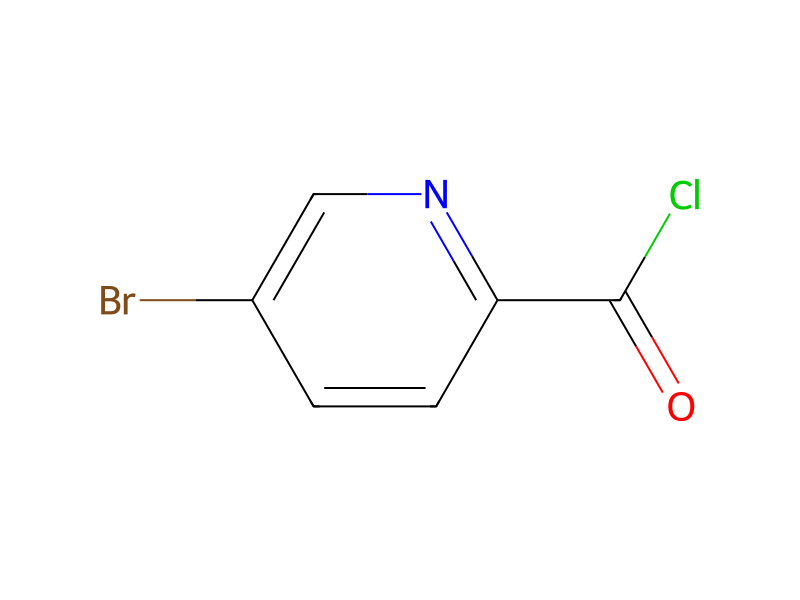
[Br:1][C:2]1[CH:3]=[CH:4][C:5]([C:8](Cl)=[O:9])=[N:6][CH:7]=1.[Cl:11][C:12]1[CH:18]=[CH:17][C:15]([NH2:16])=[CH:14][CH:13]=1.N1C=CC=CC=1.Cl>C(#N)C.CN(C)C1C=CN=CC=1.O>[Cl:11][C:12]1[CH:18]=[CH:17][C:15]([NH:16][C:8]([C:5]2[CH:4]=[CH:3][C:2]([Br:1])=[CH:7][N:6]=2)=[O:9])=[CH:14][CH:13]=1Participants
8
Reactant 4



Product 1
Reagents, catalysts & solvents 3



Conditions
- Temperature
- 68 °C
Procedure
To 5-Bromo-pyridine-2-carbonyl chloride (69, 0.76 g, 3.4 mmol) in acetonitrile (29.0 mL) were added p-chloroaniline (53, 0.702 g, 5.50 mmol), 4-dimethylamino-pyridine (0.12 g, 0.96 mmol) and pyridine (2.9 mL, 0.036 mol). The reaction was stirred at 68° C. overnight, then poured into water, acidified with 1 N HCl to pH around 1 and extracted with ethyl acetate. The organic layer was dried over anhydrous sodium sulfate and filtered. The filtrate was concentrated and purified by silica gel column chromatography eluting with dichloromethane to give a white solid (70, 0.75 g, 70.0%).
Workup
- extractionextracted with ethyl acetate
- dry with materialThe organic layer was dried over anhydrous sodium sulfate
- filtrationfiltered
- concentrationThe filtrate was concentrated
- custompurified by silica gel column chromatography
- washeluting with dichloromethane
- customto give a white solid (70, 0.75 g, 70.0%)
Sources & evidence
- ORD record
- ord-16d7393a91ad4ab5b90dbfbffdd68180
- Source dataset
- uspto-grants-2013_03
- Patent number
- US08404700B2
Reaction notes
Loading…