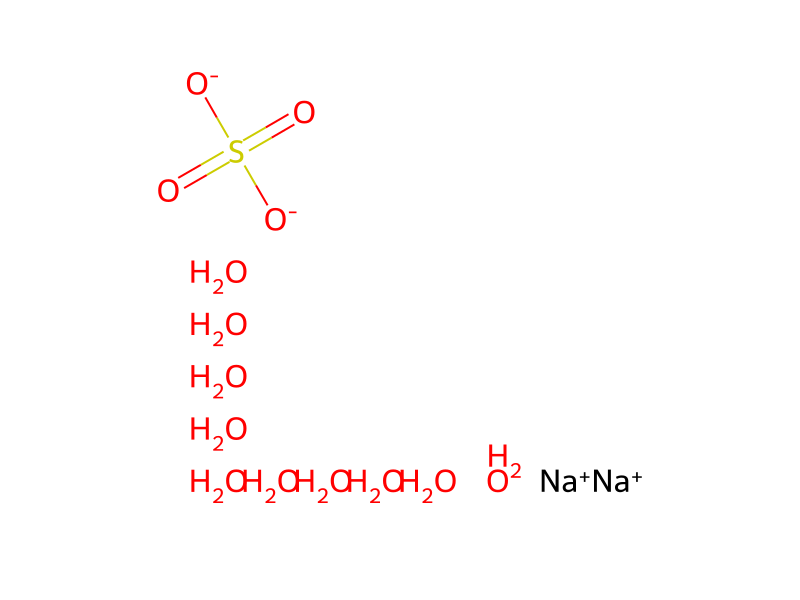
Sodium sulfate decahydrate → 2,3-dihydro-1H-indol-2-ylmethanol
Reaction equation

[NH:1]1[C:9]2[C:4](=[CH:5][CH:6]=[CH:7][CH:8]=2)[CH2:3][CH:2]1[C:10](OCC)=[O:11].[H-].[Al+3].[Li+].[H-].[H-].[H-].O.O.O.O.O.O.O.O.O.O.S([O-])([O-])(=O)=O.[Na+].[Na+]>O1CCCC1>[NH:1]1[C:9]2[C:4](=[CH:5][CH:6]=[CH:7][CH:8]=2)[CH2:3][CH:2]1[CH2:10][OH:11]Participants
Reactant 3


Product 1

Reagents, catalysts & solvents 1

Procedure
A solution of 5.12 g of ethyl indoline-2-carboxylate (prepared as described in Preparation 1) in 20 ml of anhydrous tetrahydrofuran was added dropwise, whilst ice-cooling, to a mixture of 1.20 g of lithium aluminum hydride and 80 ml of anhydrous tetrahydrofuran, and the resulting mixture was stirred at room temperature for 2 hours. After this, an excess of sodium sulfate decahydrate was added to the mixture, which was then stirred for 20 minutes. At the end of this time, insoluble materials were filtered off and the filtrate was concentrated by evaporation under reduced pressure. The concentrate was purified by column chromatography through silica gel, using a 3:1 by volume mixture of hexane and ethyl acetate as the eluent, to give 3.81 g of the title compound having Rf=0.16 (on silica gel thin layer chromatography using a 2:1 by volume mixture of hexane and ethyl acetate as the developing solvent).
Workup
- stirringwas then stirred for 20 minutes
- filtrationAt the end of this time, insoluble materials were filtered off
- concentrationthe filtrate was concentrated by evaporation under reduced pressure
- customThe concentrate was purified by column chromatography through silica gel
- additionby volume mixture of hexane and ethyl acetate as the eluent
Sources & evidence
- ORD record
- ord-676a18c6ca8648e2ad9b14e21e0c551f
- Source dataset
- uspto-grants-2000_09
- Patent number
- US06117893
Reaction notes
Loading…