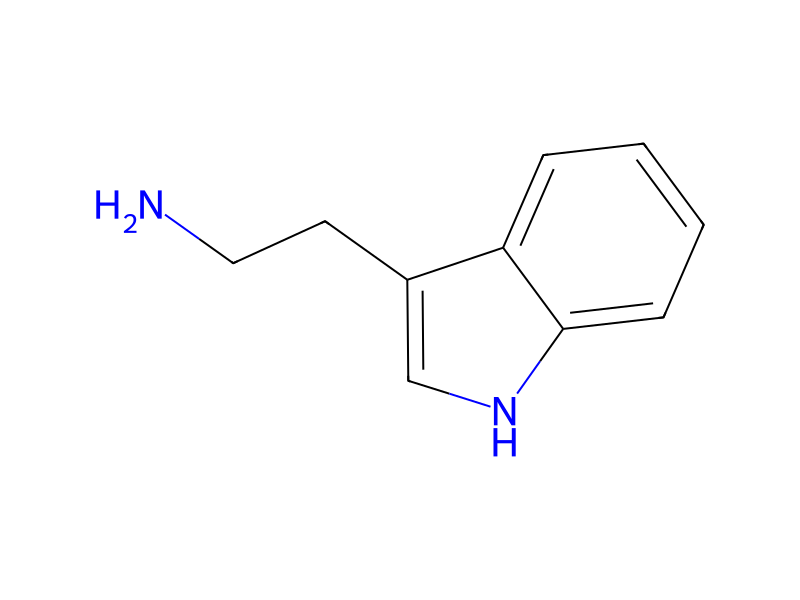
Tryptamine → HCID 22009951, compound
Reaction equation

[NH2:1][CH2:2][CH2:3][C:4]1[C:12]2[C:7](=[CH:8][CH:9]=[CH:10][CH:11]=2)[NH:6][CH:5]=1.C([N:16]1[C:20](=[O:21])[C:19]2=[CH:22][CH:23]=[CH:24][CH:25]=[C:18]2[C:17]1=[O:26])(O)=O>O1CCCC1>[C:20]1(=[O:21])[N:16]([NH:1][CH2:2][CH2:3][C:4]2[C:12]3[C:7](=[CH:8][CH:9]=[CH:10][CH:11]=3)[NH:6][CH:5]=2)[C:17](=[O:26])[C:18]2=[CH:25][CH:24]=[CH:23][CH:22]=[C:19]12Participants
Reactant 2

Product 1

Reagents, catalysts & solvents 1

Procedure
As shown in reaction Scheme A, treatment of tryptamine (1) with N-carboxyphthalimide in an inert organic solvent such as tetrahydrofuran at a temperature of 20°-65° C., preferably 65° C., for a period of 12-48 hours gives the corresponding N-phthalimidotryptamine derivative (2). The N-phthalimidotryptamine (2) could be further modified by treatment with a brominating agent such as pyridinium hydrobromide perbromide, pyrrolidone hydrotribromide, or the like in an inert organic solvent such as tetrahydrofuran, methylene chloride, chloroform, or mixtures thereof at 0°-25° C. for a period of 30 minutes to 4 hours to provide the 2-bromotryptamine (3). Bromide (3) may be reacted with an arylboronic acid (prepared essentially as described in Gronowitz, S.; Hornfeldt, A.-B.; Yang, Y.-H. Chem. Scr. 1986, 26, 311-314.) with palladium (0) catalysis, a weak base such as aqueous sodium carbonate or the like, and a chloride source such as lithium chloride in an inert solvent like toluene, benzene, ethanol, propanol or mixtures thereof at a temperature of 25°-100° C., preferably 80° C., for a period of 1-6 hours to give the 2-aryltryptamine derivative (4). Finally, the phthalimido group may be removed by treatment of (4) with aqueous hydrazine in an inert solvent such as methanol or ethanol at a temperature of 0°-25° C., for a period of 4-24 hours to give tryptamine (5). ##STR8##
Sources & evidence
- ORD record
- ord-8744d2510a434637b4ce458915f2a522
- Source dataset
- uspto-grants-1998_07
- Patent number
- US05780437
Reaction notes
Loading…