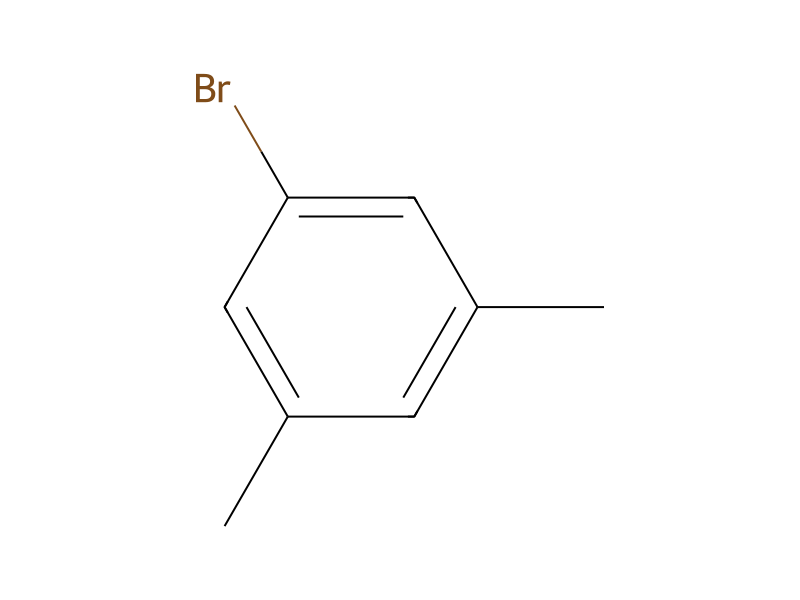
Benzene, 1-bromo-3,5-dimethyl- → HCID 15458520, compound
Reaction equation

Br[C:2]1[CH:3]=[C:4]([CH3:9])[CH:5]=[C:6]([CH3:8])[CH:7]=1.C([Li])CCC.[Cl:15][CH2:16][CH2:17][CH2:18][C:19](N(OC)C)=[O:20]>O1CCCC1>[CH3:9][C:4]1[CH:3]=[C:2]([C:19]([CH2:18][CH2:17][CH2:16][Cl:15])=[O:20])[CH:7]=[C:6]([CH3:8])[CH:5]=1Participants
Reactant 3


Product 1

Reagents, catalysts & solvents 1

Conditions
- Temperature
- -78 °C
Procedure
A solution of 10.2 mL (13.9 g; 72 mmol) 5-bromo-m-xylene in 200 mL of anhydrous tetrahydrofuran was stirred under nitrogen at -78° C. as 35.8 mL (84 mmol) of 2.5m n-butyllithium in tetrahydrofuran was added dropwise. After 15 minutes at -78° C., a solution of 10.0 g (60 mmol) of 4-chloro-N-methoxy-N-methylbutyramide in 30 mL of anhydrous tetrahydrofuran was added dropwise over 25-30 minutes. The resulting solution was maintained at -78° C. for 45 minutes and then warmed briefly to room temperature. The reaction was quenched by addition of 40 mL of 2N hydrochloric acid and then partitioned between ethyl acetate and water. The organic phase was washed with saturated aqueous sodium bicarbonate solution and then saturated aqueous sodium chloride solution. The organic solution was dried over sodium sulfate, filtered, and concen trated in vacuo. Flash chromatography of the residue afforded 8.91 g (70%) of an oil, which had satisfactory purity by 1H NMR (CDCl3).
Workup
- additionwas added dropwise
- temperaturewarmed briefly to room temperature
- customThe reaction was quenched by addition of 40 mL of 2N hydrochloric acid
- custompartitioned between ethyl acetate and water
- washThe organic phase was washed with saturated aqueous sodium bicarbonate solution
- dry with materialThe organic solution was dried over sodium sulfate
- filtrationfiltered
Sources & evidence
- ORD record
- ord-5898625fb06a48229b6e1eccd2f015cf
- Source dataset
- uspto-grants-1998_07
- Patent number
- US05780437
Reaction notes
Loading…