Benzaldehyde → 2,3-Dihydroxybutanedioic Acid
Reaction equation

[C:1]([OH:10])(=[O:9])[C@@H:2]([C@H:4]([C:6]([OH:8])=[O:7])[OH:5])[OH:3].NC1CCC2C=CC=CC=2N(CC(OC(C)(C)C)=O)C1=O.C(=O)C1C=CC=CC=1>C(O)C>[C:1]([OH:10])(=[O:9])[CH:2]([CH:4]([C:6]([OH:8])=[O:7])[OH:5])[OH:3]Participants
Reactant 3

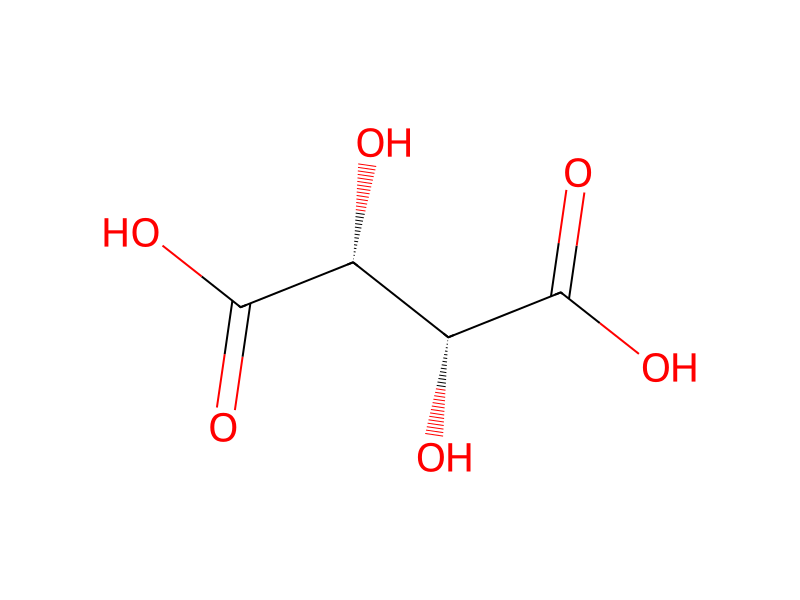

Product 1

Reagents, catalysts & solvents 1

Procedure
A solution of 12.65 g of L-(+)-tartaric acid in 54 ml of ethanol which had been heated to 650° C. was added to a solution, which had been heated to 65° C., of 24.5 g of the racemic tert-butyl 3-amino-2,3,4,5-tetrahydro-2-oxo-1H-1-benzazepine-1-acetate (preparation, see Example II). The reaction mixture was stirred at room temperature for one hour. A solution of 1.72 ml of benzaldehyde in 1.3 ml of ethanol was then added dropwise. The resulting suspension was boiled under reflux at 800° C. for 14 hours and then cooled down to room temperature. The resulting crystalline precipitate was filtered out with suction and taken up in 80 ml of ethanol; this solution was boiled under reflux for a further 8 hours. It was then cooled down to room temperature and the crystals were filtered out with suction and dried at 50° C. under reduced pressure. 23.6 g of tartaric acid salt were obtained with a melting point of from 195° to 196° C. and an optical rotation value [α]20D of -152° C. (c=0.5 in methanol). In order to liberate the base, 23.6 g of the tartaric acid salt in a mixture consisting of 250 ml of water and 108 ml of dichloromethane were cooled down to 0° C., while being stirred, and adjusted to pH 9.6 by adding aqueous ammonium solution. The organic phase was separated, and the aqueous phase was extracted with a further 30 ml of dichloromethane; the organic phases were combined, dried over sodium sulfate and concentrated under reduced pressure. The remaining residue was crystallized from methyl tert-butyl ether and dried under reduced pressure. 12.2 g of tert-butyl (3S) -3-amino-2,3,4,5-tetrahydro-2-oxo-1H-1-benzazepine-1-acetate were obtained with a melting point of from 113° to 115° C. and an optical rotation value [α]20D of -276.2° (c=0.5 in methanol).
Workup
- additionwas added to a solution, which
- temperatureunder reflux at 800° C. for 14 hours
- temperaturecooled down to room temperature
- filtrationThe resulting crystalline precipitate was filtered out with suction
- temperatureunder reflux for a further 8 hours
- temperatureIt was then cooled down to room temperature
- filtrationthe crystals were filtered out with suction
- customdried at 50° C. under reduced pressure
Sources & evidence
- ORD record
- ord-ebbcab7e117044c3b9d5619425893e0b
- Source dataset
- uspto-grants-1998_07
- Patent number
- US05783573
Reaction notes
Loading…