Potassium Phosphate, Tribasic → 2-(4-Hydroxyphenyl)naphthalene-1,4-dione
Reaction equation

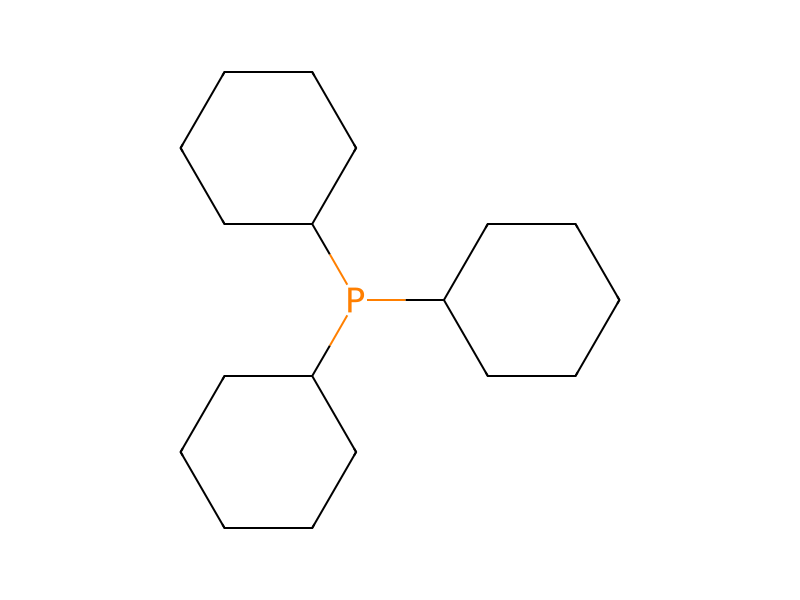
Br[C:2]1[C:3](=[O:13])[C:4]2[C:9]([C:10](=[O:12])[CH:11]=1)=[CH:8][CH:7]=[CH:6][CH:5]=2.[OH:14][C:15]1[CH:20]=[CH:19][C:18](B(O)O)=[CH:17][CH:16]=1.P([O-])([O-])([O-])=O.[K+].[K+].[K+].C1(P(C2CCCCC2)C2CCCCC2)CCCCC1>C([O-])(=O)C.[Pd+2].C([O-])(=O)C.O.C1(C)C=CC=CC=1>[OH:14][C:15]1[CH:20]=[CH:19][C:18]([C:2]2[C:3](=[O:13])[C:4]3[C:9]([C:10](=[O:12])[CH:11]=2)=[CH:8][CH:7]=[CH:6][CH:5]=3)=[CH:17][CH:16]=1Participants
Reactant 4



Product 1

Reagents, catalysts & solvents 3



Conditions
- Temperature
- 100 °C
Procedure
An example compound, 2-(4-hydroxy-phenyl)-[1,4]naphthoquinone was synthesized in the following way. To a mixture of 2-bromo-1,4-naphthoquinone (1.0 g, 4.22 mmol), 4-hydroxy phenyl boronic acid (640 mg, 4.64 mmol), potassium phosphate (3.135 g, 14.76 mmol), tri cyclo hexyl phosphine (118 mg, 0.422 mmol), toluene (20 mL) and water (1 mL) was added palladium acetate (47 mg, 0.21 mmol) under nitrogen. The reaction mix was heated to ˜100° C. for 3 h and then cooled to room temperature. Water was added and the mixture was extracted with ethyl acetate. The organic layer was separated, washed with water, brine, dried and concentrated to give crude product, which was purified by column chromatography, using 10% ethyl acetate in hexane to give (480 mg, 45% yield) of 2-(4-Hydroxy-phenyl)-[1,4]naphthoquinone; MS (ES) m/z, 251.03 (M+1).
Workup
- customAn example compound, 2-(4-hydroxy-phenyl)-[1,4]naphthoquinone was synthesized in the following way
- additionThe reaction mix
- temperaturecooled to room temperature
- extractionthe mixture was extracted with ethyl acetate
- customThe organic layer was separated
- washwashed with water, brine
- customdried
- concentrationconcentrated
- customto give crude product, which
- customwas purified by column chromatography
Sources & evidence
- ORD record
- ord-7cec4327350741d59d7ec75ce8915c4a
- Source dataset
- uspto-grants-2013_04
- Patent number
- US08410109B2
Reaction notes
Loading…