Hydroxylamine → (E)-4-bromo-1-naphthaldehyde oxime
Reaction equation

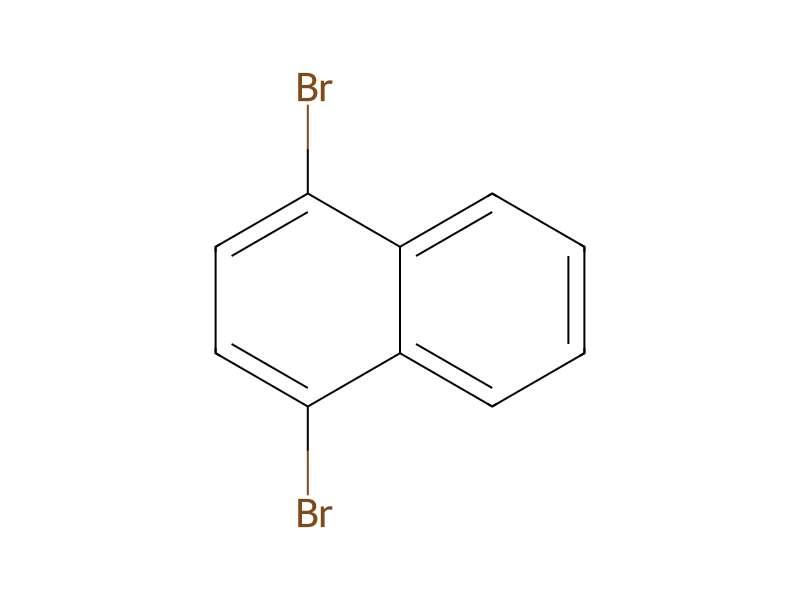
[NH2:1][OH:2].[Br:3][C:4]1[C:13]2[C:8](=[CH:9][CH:10]=[CH:11][CH:12]=2)[C:7]([CH:14]=O)=[CH:6][CH:5]=1.BrC1C2C(=CC=CC=2)C(Br)=CC=1>C(O)C>[Br:3][C:4]1[C:13]2[C:8](=[CH:9][CH:10]=[CH:11][CH:12]=2)[C:7]([CH:14]=[N:1][OH:2])=[CH:6][CH:5]=1Participants
5
Reactant 3


Product 1

Reagents, catalysts & solvents 1

Procedure
An aqueous solution of hydroxylamine (1.25 mL, 50% in water) was added to a stirred solution of 4-bromo-1-naphthalenecarboxaldehyde (3.7 g, 15.7 mmol, prepared from commercially available 1,4-dibromonaphthalene by the method described in European Journal of Organic Chemistry 2006, 10, 2329-2335) in ethanol (30 mL). After stirring at room temperature for 3 h, the reaction mixture was concentrated under reduced pressure to provide the title compound as a pale yellow solid (3.8 g). 1H NMR (Me2S(O)-d6): δ 11.60 (s, 1H), 8.81 (s, 1H), 8.71 (d, 1H), 8.24 (d, 1H), 7.95 (d, 1H), 7.74 (m, 3H).
Workup
- concentrationthe reaction mixture was concentrated under reduced pressure
Sources & evidence
- ORD record
- ord-27d8c234ddaf4d159c26b8b41d90cfa7
- Source dataset
- uspto-grants-2013_04
- Patent number
- US08410153B2
Reaction notes
Loading…