Sodium Hydroxide → 5-Chloro-4-(4-chloro-1-methyl-1H-pyrazol-5-yl)thiophene-2-carboxylic acid
Reaction equation
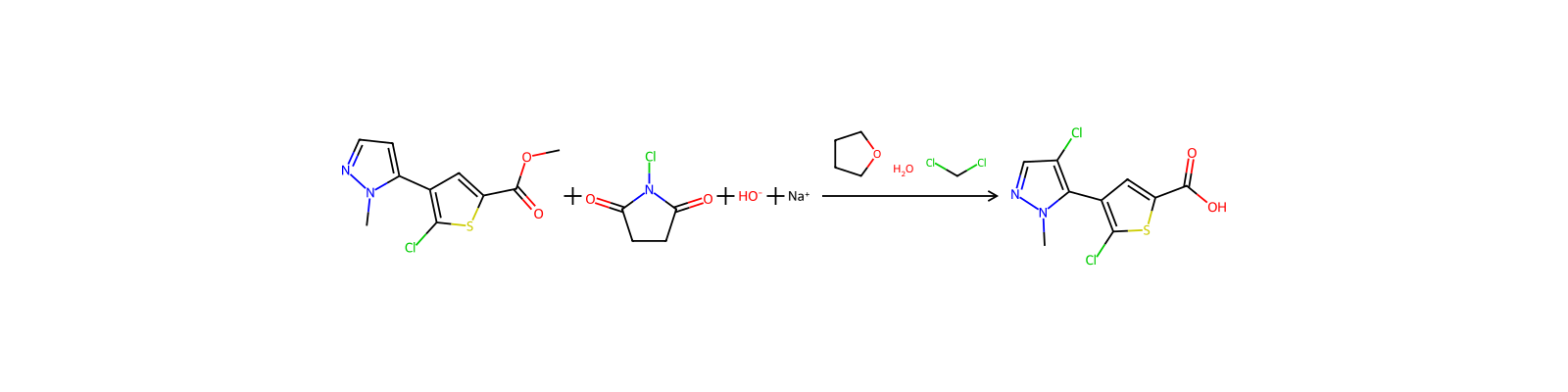
[Cl:1][C:2]1[S:6][C:5]([C:7]([O:9]C)=[O:8])=[CH:4][C:3]=1[C:11]1[N:15]([CH3:16])[N:14]=[CH:13][CH:12]=1.C1C(=O)N([Cl:24])C(=O)C1.[OH-].[Na+]>O1CCCC1.O.C(Cl)Cl>[Cl:1][C:2]1[S:6][C:5]([C:7]([OH:9])=[O:8])=[CH:4][C:3]=1[C:11]1[N:15]([CH3:16])[N:14]=[CH:13][C:12]=1[Cl:24]Participants
7
Reactant 3



Product 1

Reagents, catalysts & solvents 3



Conditions
- Temperature
- 70 °C
Procedure
To a 500 mL flask was added methyl 5-chloro-4-(1-methyl-1H-pyrazol-5-yl)-2-thiophenecarboxylate (5 g, 19.48 mmol) [from Example 95] and NCS (3.12 g, 23.37 mmol) in tetrahydrofuran (THF) (100 ml) (50 mL). After stirring for 4 h at 70° C., the yellow reaction solution was treated with 6M NaOH (32 mL, 195 mmole) and stirred an additional 2 hours. The reaction solution was diluted with H2O (50 mL) and DCM (200 mL). The organic layer was separated and the aqueous layer made acidic with 6N HCl. The acidic aqueous solution was extracted with DCM (3×200 mL), dried over Na2SO4, and concentrated to give the crude product [2.6 g, 48%] as a tan solid: LCMS (ES) m/z 277 (M+H)+.
Workup
- stirringstirred an additional 2 hours
- customThe organic layer was separated
- extractionThe acidic aqueous solution was extracted with DCM (3×200 mL)
- dry with materialdried over Na2SO4
- concentrationconcentrated
Sources & evidence
- ORD record
- ord-57a458a81a944fb3b5c568e015d7f509
- Source dataset
- uspto-grants-2013_04
- Patent number
- US08410158B2
Reaction notes
Loading…