Hydrochloric Acid → HCID 66732272, compound
Reaction equation

Cl[C:2]1[CH:3]=[C:4]([CH:9]=[CH:10][N:11]=1)[C:5]([O:7][CH3:8])=[O:6].[Br-].[F:13][C:14]([F:25])([F:24])[O:15][C:16]1[CH:23]=[CH:22][C:19]([CH2:20][Zn+])=[CH:18][CH:17]=1.Cl>O1CCCC1.C1C=CC([P]([Pd]([P](C2C=CC=CC=2)(C2C=CC=CC=2)C2C=CC=CC=2)([P](C2C=CC=CC=2)(C2C=CC=CC=2)C2C=CC=CC=2)[P](C2C=CC=CC=2)(C2C=CC=CC=2)C2C=CC=CC=2)(C2C=CC=CC=2)C2C=CC=CC=2)=CC=1>[F:13][C:14]([F:24])([F:25])[O:15][C:16]1[CH:23]=[CH:22][C:19]([CH2:20][C:2]2[CH:3]=[C:4]([CH:9]=[CH:10][N:11]=2)[C:5]([O:7][CH3:8])=[O:6])=[CH:18][CH:17]=1Participants

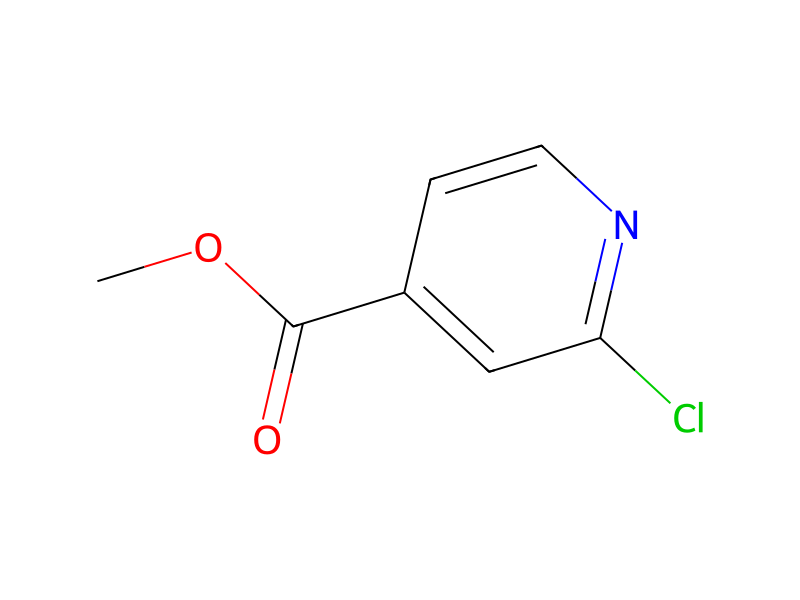




Conditions
- Temperature
- 60 °C
Procedure
To a solution of methyl 2-chloroisonicotinate (4.80 g, 28 mmol) and Pd(PPh3)4 (0.647 g, 0.56 mmol) in tetrahydrofuran (50 mL) under nitrogen in a dried flask was added a freshly prepared solution of (4-(trifluoromethoxy)benzyl)zinc(II) bromide (12.56 g, 39.20 mmol) in tetrahydrofuran (90 mL). The resulting bright yellow mixture was heated to 60° C. for 2 h 30 min, then cooled to room temperature. The reaction was quenched by the addition of 10% aqueous NH4Cl. It was diluted with ethyl acetate. After phase separation, the organic layer was washed with brine, dried over MgSO4 and evaporated. The residue was suspended in 50 mL MTBE and sonicated, then the yellow insolubles were filtered off and washed with MTBE. The volume of the filtrate was increased to ca. 150 mL, then 5 mL MeOH was added, followed by hydrogen chloride (4 M in dioxane) (7.00 mL, 28.00 mmol). A colorless precipitate formed, which then dissolved again. The solvents were evaporated. The residue was dissolved in ca. 15 mL DCM and then MTBE and heptanes were added. An oil had formed that was triturated and after a few minutes a solid started to form. It was sonicated and then stirred at room temperature for 20 min. The formed solid was collected and washed with MTBE and dried. The solid was dissolved in DCM and washed with 10% K2CO3. After phase separation, the aqueous layer was extracted with DCM. The combined organic layers were dried over MgSO4 and evaporated. Methyl 2-(4-(trifluoromethoxy)benzyl)isonicotinate (8.04 g, 92%) was isolated as a pale yellow oil. 1H NMR (400 MHz, cdcl3) δ 3.93 (s, 3H), 4.22 (s, 2H), 7.11-7.17 (m, 2H), 7.24-7.31 (m, 2H), 7.67-7.72 (m, 2H), 8.68-8.72 (m, 1H). MS m/z 312 (M+H)+
Workup
- temperaturecooled to room temperature
- customThe reaction was quenched by the addition of 10% aqueous NH4Cl
- additionIt was diluted with ethyl acetate
- customAfter phase separation
- washthe organic layer was washed with brine
- dry with materialdried over MgSO4
- customevaporated
- customsonicated
- filtrationthe yellow insolubles were filtered off
- washwashed with MTBE
- temperatureThe volume of the filtrate was increased to ca. 150 mL
- addition5 mL MeOH was added
- customA colorless precipitate formed
- dissolutionwhich then dissolved again
- customThe solvents were evaporated
- dissolutionThe residue was dissolved in ca. 15 mL DCM
- additionMTBE and heptanes were added
- customAn oil had formed
- customthat was triturated and after a few minutes a solid
- customto form
- customIt was sonicated
- customThe formed solid was collected
- washwashed with MTBE
- customdried
- dissolutionThe solid was dissolved in DCM
- washwashed with 10% K2CO3
- customAfter phase separation
- extractionthe aqueous layer was extracted with DCM
- dry with materialThe combined organic layers were dried over MgSO4
- customevaporated
Sources & evidence
- ORD record
- ord-c85ce13be79b4bf3a6be0ae0bb3a12ee
- Source dataset
- uspto-grants-2013_04
- Patent number
- US08415378B2
Reaction notes
Loading…