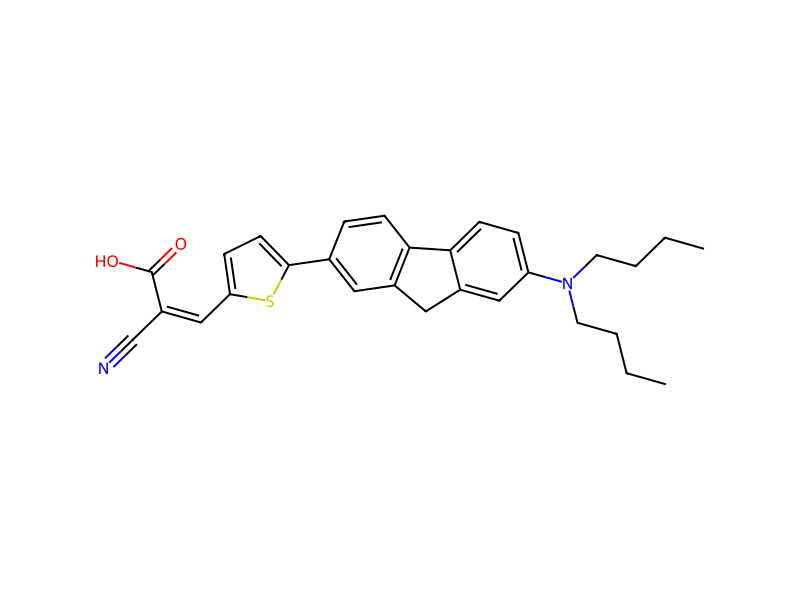
Cyanoacetic acid → 2-cyano-3-[5-(7-dibutylamino-9H-fluoren-2-yl)-thiophen-2-yl]-acrylic acid
Reaction equation

[CH2:1]([N:5]([CH2:26][CH2:27][CH2:28][CH3:29])[C:6]1[CH:18]=[C:17]2[C:9]([C:10]3[CH:11]=[CH:12][C:13]([C:19]4[S:23][C:22]([CH:24]=O)=[CH:21][CH:20]=4)=[CH:14][C:15]=3[CH2:16]2)=[CH:8][CH:7]=1)[CH2:2][CH2:3][CH3:4].[C:30]([CH2:32][C:33]([OH:35])=[O:34])#[N:31]>C(#N)C.N1CCCCC1>[C:30]([C:32](=[CH:24][C:22]1[S:23][C:19]([C:13]2[CH:12]=[CH:11][C:10]3[C:9]4[C:17](=[CH:18][C:6]([N:5]([CH2:1][CH2:2][CH2:3][CH3:4])[CH2:26][CH2:27][CH2:28][CH3:29])=[CH:7][CH:8]=4)[CH2:16][C:15]=3[CH:14]=2)=[CH:20][CH:21]=1)[C:33]([OH:35])=[O:34])#[N:31]Participants
5




Procedure
As shown in Scheme 1, 7-bromo-9H-fluoren-2-ylamine is reacted with 1-iodobutane to form (7-bromo-9H-fluoren-2-yl)-dibutyl amine (11). Then, (7-bromo-9H-fluoren-2-yl)-dibutyl amine (11) is reacted with 5-formyl-2-thiopheneboronic acid by Suzuki coupling reaction to obtain 5-(7-dibutylamino-9H-fluoren-2-yl)-thiophene-2-carbaldehyde (12a). Finally, in acetonitrile, 5-(7-dibutylamino-9H-fluoren-2-yl)-thiophene-2-carbaldehyde (12a) is reacted with cyanoacetic acid by using piperidine as a catalyst, to obtain 2-cyano-3-[5-(7-dibutylamino-9H-fluoren-2-yl)-thiophen-2-yl]-acrylic acid (13a).
Sources & evidence
- ORD record
- ord-63a4874a61c4458b9dd28b24cea18349
- Source dataset
- uspto-grants-2013_04
- Patent number
- US08419808B2
Reaction notes
Loading…