Sodium hydride → 2,2,3,3-Tetrafluoro-4-{[(2E)-3-phenylprop-2-en-1-yl]oxy}butan-1-ol
Reaction equation

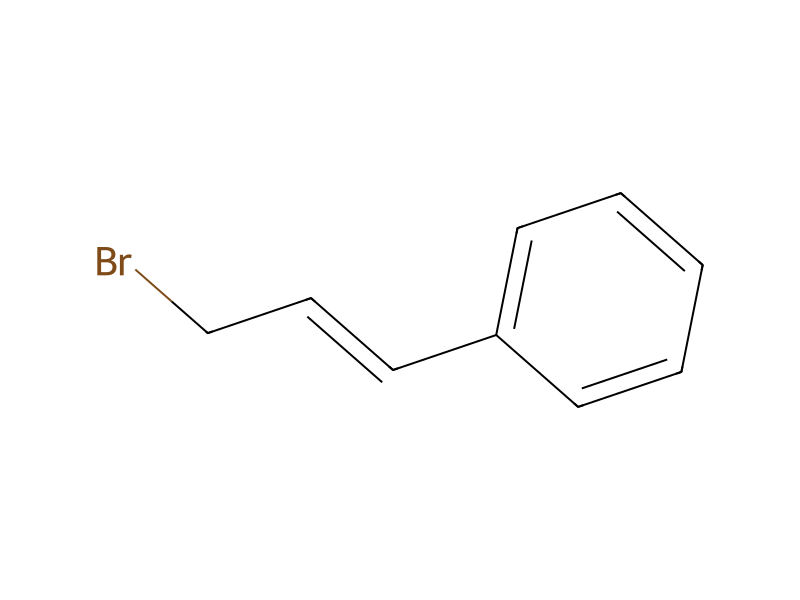
[F:1][C:2]([F:10])([C:5]([F:9])([F:8])[CH2:6][OH:7])[CH2:3][OH:4].[H-].[Na+].[CH2:13](Br)[CH:14]=[CH:15][C:16]1[CH:21]=[CH:20][CH:19]=[CH:18][CH:17]=1>CN(C)C=O>[F:1][C:2]([F:10])([C:5]([F:9])([F:8])[CH2:6][O:7][CH2:13]/[CH:14]=[CH:15]/[C:16]1[CH:21]=[CH:20][CH:19]=[CH:18][CH:17]=1)[CH2:3][OH:4]Participants
5




Procedure
To a solution 2,2,3,3-tetrafluoro-1,4-butanediol (2.0 g, 12.3 mmol) in dimethylformamide (30 mL) was added 60% sodium hydride (0.140 g, 18.4 mmol). The mixture was stirred at room temperature for 1.30 hours. Then, a solution of cinnamyl bromide (3.2 g, 12.3 mmol) in dimethylformamide (40 mL) was added. The mixture was stirred at room temperature overnight and concentrated. The residue was dissolved with ethyl acetate (50 mL), washed with water (2×25 mL) and brine (25 mL), dried (Na2SO4), and the solvent removed under reduced pressure. Purification by column chromatography with silica gel and n-hexane/ethyl acetate (from pure n-hexane to 5:1) gave the title compound (1.8 g, 54%) as oil.
Workup
- stirringThe mixture was stirred at room temperature overnight
- concentrationconcentrated
- dissolutionThe residue was dissolved with ethyl acetate (50 mL)
- washwashed with water (2×25 mL) and brine (25 mL)
- dry with materialdried (Na2SO4)
- customthe solvent removed under reduced pressure
- customPurification by column chromatography with silica gel and n-hexane/ethyl acetate (from pure n-hexane to 5:1)
Sources & evidence
- ORD record
- ord-63f7c7a6636248e68bbad7c5f996bb41
- Source dataset
- uspto-grants-2013_04
- Patent number
- US08420669B2
Reaction notes
Loading…