Diisopropylethylamine → N-(3-(6-(4-(1,4-Dimethyl-3-oxopiperazin-2-yl)phenylamino)-4-methyl-5-oxo-4,5-dihydropyrazin-2-yl)-2-methylphenyl)-4,5,6,7-tetrahydro-4,7-methanobenzo[b]thiophene-2-carboxamide
Reaction equation

[S:1]1[C:5]([C:6]([OH:8])=O)=[CH:4][C:3]2[CH:9]3[CH2:13][CH:12]([C:2]1=2)[CH2:11][CH2:10]3.[NH2:14][C:15]1[C:16]([CH3:45])=[C:17]([C:21]2[N:22]=[C:23]([NH:29][C:30]3[CH:35]=[CH:34][C:33]([CH:36]4[C:41](=[O:42])[N:40]([CH3:43])[CH2:39][CH2:38][N:37]4[CH3:44])=[CH:32][CH:31]=3)[C:24](=[O:28])[N:25]([CH3:27])[CH:26]=2)[CH:18]=[CH:19][CH:20]=1.C(N(CC)C(C)C)(C)C.F[P-](F)(F)(F)(F)F.N1(O[P+](N(C)C)(N(C)C)N(C)C)C2C=CC=CC=2N=N1>O.CN(C=O)C>[CH3:44][N:37]1[CH2:38][CH2:39][N:40]([CH3:43])[C:41](=[O:42])[CH:36]1[C:33]1[CH:34]=[CH:35][C:30]([NH:29][C:23]2[C:24](=[O:28])[N:25]([CH3:27])[CH:26]=[C:21]([C:17]3[C:16]([CH3:45])=[C:15]([NH:14][C:6]([C:5]4[S:1][C:2]5[CH:12]6[CH2:13][CH:9]([C:3]=5[CH:4]=4)[CH2:10][CH2:11]6)=[O:8])[CH:20]=[CH:19][CH:18]=3)[N:22]=2)=[CH:31][CH:32]=1Participants
Reactant 4
 HCID 81531Diisopropylethylamine
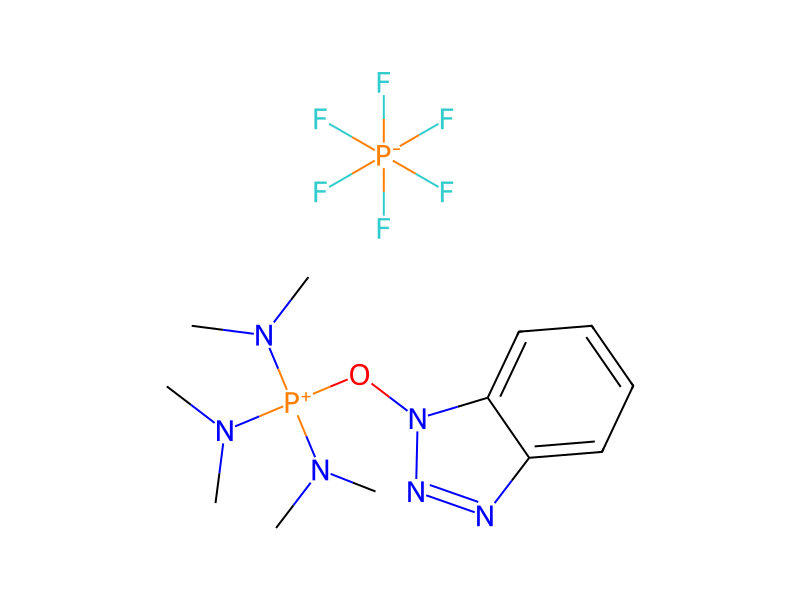 HCID 151348Benzotriazol-1-yloxy-tris(dimethylamino)phosphonium hexafluorophosphate
 HCID 576251475-(3-Amino-2-methylphenyl)-3-(4-(1,4-dimethyl-3-oxopiperazin-2-yl)phenylamino)-1-methylpyrazin-2(1H)-one
 HCID 582669813-Thiatricyclo(5.2.1.0,2,6)deca-2(6),4-diene-4-carboxylic acid
Product 1

Reagents, catalysts & solvents 2


Conditions
- Temperature
- 60 °C
Procedure
A 50-mL single-neck round-bottomed flask equipped with a magnetic stirrer was purged with nitrogen and charged with 1e (100 mg, 0.515 mmol), 1p (203 mg, 0.469 mmol), N,N-diisopropylethylamine (242 mg, 1.88 mmol) and anhydrous DMF (2 mL). Benzotriazol-1-yl-oxy-tris(dimethylamino)phosphonium hexafluorophosphate (BOP, 249 mg, 0.563 mmol) was added, and the reaction was heated at 60° C. for 16 h. After this time, the reaction was diluted with water (10 mL), and the resulting suspension was filtered. The filter cake was dissolved in methylene chloride (20 mL), and the solution was washed with 10% aqueous citric acid (10 mL), saturated aqueous sodium bicarbonate (10 mL), and water (10 mL), and dried over sodium sulfate. The drying agent was removed by filtration, and the solvent was evaporated under reduced pressure. The resulting residue was eluted with a gradient from 0% to 20% of methanol in ethyl acetate, and the fractions containing 1q were collected to afford, after concentrating under reduced pressure, a 44% yield (127 mg) of 1q as an off-white solid: mp 178-179° C.; 1H NMR (500 MHz, CD2Cl2) δ 8.35 (s, 1H), 7.85 (d, 1H, J=8.0 Hz), 7.77 (d, 2H, J=8.5 Hz), 7.59 (s, 1H), 7.42 (s, 1H), 7.29-7.22 (m, 4H), 6.76 (s, 1H), 3.68 (td, 1H, J=11.5, 4.5 Hz), 3.62-3.60 (m, 2H), 3.58 (s, 3H), 3.47 (m, 1H), 3.18 (m, 1H), 2.97 (m, 1H), 2.91 (s, 3H), 2.64 (m, 1H), 2.39 (s, 3H), 2.13 (s, 3H), 1.98-1.90 (m, 3H), 1.67 (dt, 1H, J=9.0, 2.5 Hz), 1.10 (dd, 2H, J=12.5, 3.5 Hz); MS (ESI+) m/z 609.3 (M+H).
Workup
- customA 50-mL single-neck round-bottomed flask equipped with a magnetic stirrer
- customwas purged with nitrogen
- filtrationthe resulting suspension was filtered
- dissolutionThe filter cake was dissolved in methylene chloride (20 mL)
- washthe solution was washed with 10% aqueous citric acid (10 mL), saturated aqueous sodium bicarbonate (10 mL), and water (10 mL)
- dry with materialdried over sodium sulfate
- customThe drying agent was removed by filtration
- customthe solvent was evaporated under reduced pressure
- washThe resulting residue was eluted with a gradient from 0% to 20% of methanol in ethyl acetate
- additionthe fractions containing 1q
- customwere collected
- customto afford
- concentrationafter concentrating under reduced pressure
Sources & evidence
- ORD record
- ord-ce75a70e09f44a3e8797600b2e433244
- Source dataset
- uspto-grants-2013_04
- Patent number
- US08426424B2
Reaction notes
Loading…