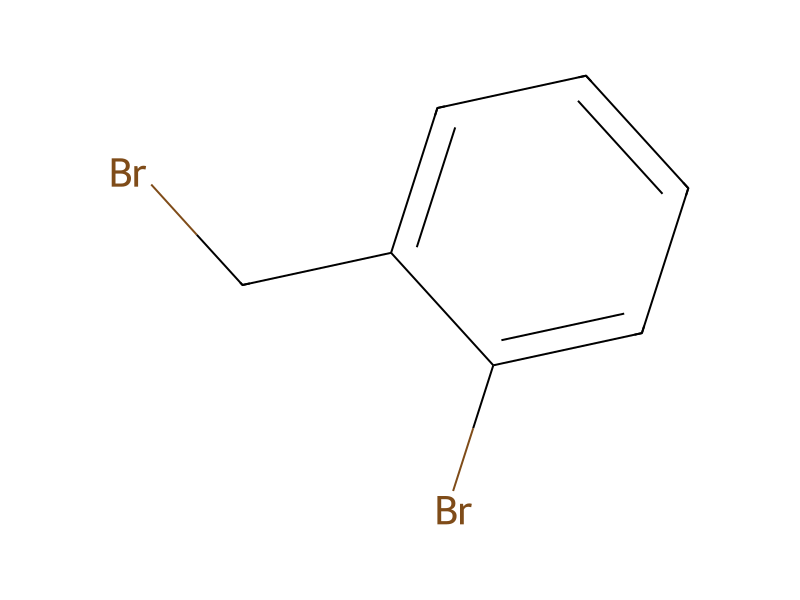
2-Bromobenzyl bromide → Ethyl 4-(4-(2-Bromobenzyl)piperazin-1-yl)benzoate
Reaction equation

[N:1]1([C:7]2[CH:17]=[CH:16][C:10]([C:11]([O:13][CH2:14][CH3:15])=[O:12])=[CH:9][CH:8]=2)[CH2:6][CH2:5][NH:4][CH2:3][CH2:2]1.[Br:18][C:19]1[CH:26]=[CH:25][CH:24]=[CH:23][C:20]=1[CH2:21]Br.C(N(C(C)C)CC)(C)C>C(#N)C>[Br:18][C:19]1[CH:26]=[CH:25][CH:24]=[CH:23][C:20]=1[CH2:21][N:4]1[CH2:3][CH2:2][N:1]([C:7]2[CH:8]=[CH:9][C:10]([C:11]([O:13][CH2:14][CH3:15])=[O:12])=[CH:16][CH:17]=2)[CH2:6][CH2:5]1Participants
5
Reactant 3


Product 1

Reagents, catalysts & solvents 1

Procedure
A solution of EXAMPLE 1B (23.43 g, 100.0 mmol), 2-bromobenzyl bromide (26.24 g, 105.0 mmol) and diisopropylethylamine (20.94 mL, 120 0 mmol) in acetonitrile (200 mL) was stirred at room temperature for two hours. The resulting precipitate was collected by filtration to give the title compound, which was used without further purification.
Workup
- filtrationThe resulting precipitate was collected by filtration
Sources & evidence
- ORD record
- ord-a3ada4b2bbc4464d938dfb17e824f994
- Source dataset
- uspto-grants-2013_04
- Patent number
- US08426422B2
Reaction notes
Loading…