Ethylene Glycol → Ethyl 8-ethyl-1,4-dioxaspiro[4,4]nonane-7-carboxylate
Reaction equation
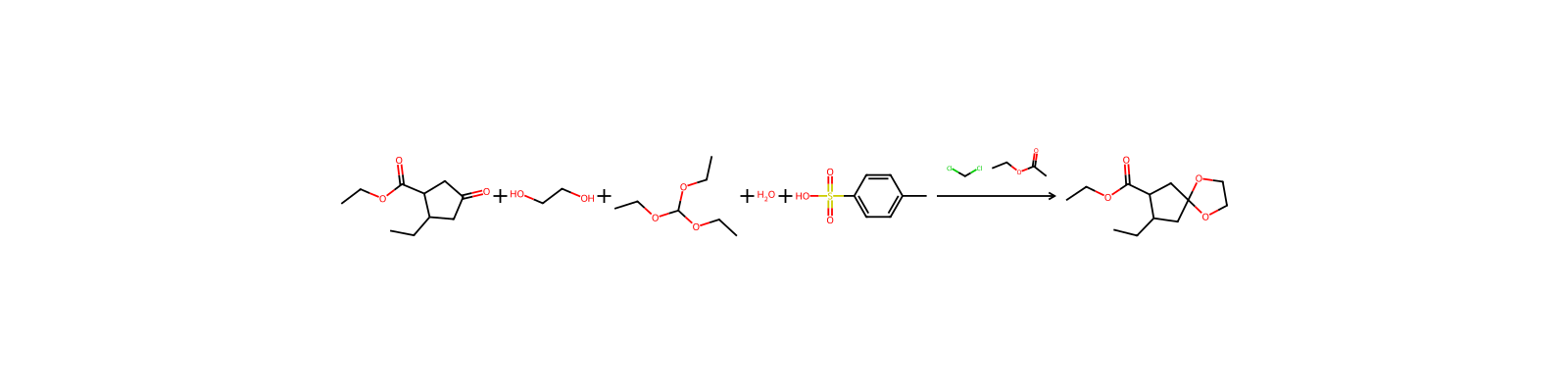
[CH2:1]([CH:3]1[CH2:7][C:6](=[O:8])[CH2:5][CH:4]1[C:9]([O:11][CH2:12][CH3:13])=[O:10])[CH3:2].[CH2:14](O)[CH2:15][OH:16].C(OC(OCC)OCC)C.O.C1(C)C=CC(S(O)(=O)=O)=CC=1>C(Cl)Cl.CCOC(C)=O>[CH2:1]([CH:3]1[CH2:7][C:6]2([O:16][CH2:15][CH2:14][O:8]2)[CH2:5][CH:4]1[C:9]([O:11][CH2:12][CH3:13])=[O:10])[CH3:2]Participants
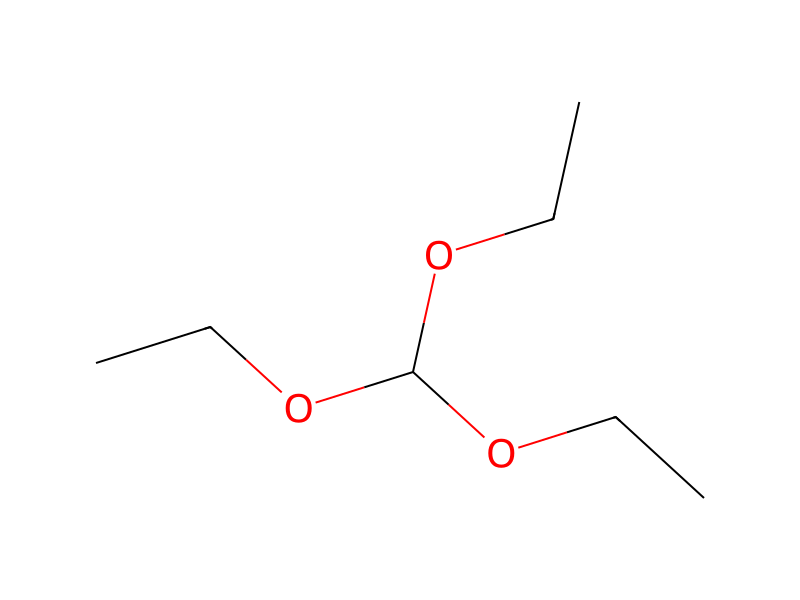
Reactant 4



Product 1

Reagents, catalysts & solvents 2


Procedure
A round bottom flask was charged with ethyl 2-ethyl-4-oxocyclopentanecarboxylate (1.5 g, 8.1 mmol, Example #22, Step B) in DCM (22 mL). To the flask were added ethylene glycol (0.91 mL, 16 mmol), triethylorthoformate (2.0 mL, 12 mmol), and p-toluenesulfonic acid monohydrate (0.31 g, 1.6 mmol). The reaction mixture was stirred at rt for about 24 h. The solution was concd under reduced pressure to give brown oil that was dissolved in EtOAc and purified by silica gel chromatography eluting with a gradient of 0-50% EtOAc in heptane. The product containing fractions were combined and concd to dryness under reduced pressure to give ethyl 8-ethyl-1,4-dioxaspiro[4,4]nonane-7-carboxylate as a light yellow oil (1.6 g, 83%): LC/MS (Table 1, Method c) MS m/z 229 (M+H)+; 1H NMR (CDCl) δ 4.14 (q, 2H), 3.90 (m, 4H), 2.99 (q, 1H), 2.32-2.27 (m, 1H), 2.26-2.11 (m, 1H), 2.05-1.99 (m, 1H), 1.96-1.91 (m, 1H), 1.83-1.78 (m, 1H), 1.46-1.39 (m, 1H), 1.31-1.24 (m, 1H), 1.26 (t, 3H), 0.90 (t, 3H).
Workup
- customto give brown oil that
- custompurified by silica gel chromatography
- washeluting with a gradient of 0-50% EtOAc in heptane
- additionThe product containing fractions
Sources & evidence
- ORD record
- ord-d32f462ea6ff4b2f9d6012fa50a02ef7
- Source dataset
- uspto-grants-2013_04
- Patent number
- US08426411B2
Reaction notes
Loading…