Phenylacetyl chloride → HCID 67002629, compound
Reaction equation

[NH2:1][C:2]1[C:7]([CH2:8][C:9]2[CH:14]=[CH:13][CH:12]=[CH:11][CH:10]=2)=[N:6][C:5]([C:15]2[CH:20]=[CH:19][C:18]([O:21][CH3:22])=[CH:17][CH:16]=2)=[CH:4][N:3]=1.[C:23]1([CH2:29][C:30](Cl)=[O:31])[CH:28]=[CH:27][CH:26]=[CH:25][CH:24]=1.C(=O)(O)[O-].[Na+]>N1C=CC=CC=1.CN(C)C1C=CN=CC=1>[CH2:8]([C:7]1[C:2]([NH:1][C:30](=[O:31])[CH2:29][C:23]2[CH:28]=[CH:27][CH:26]=[CH:25][CH:24]=2)=[N:3][CH:4]=[C:5]([C:15]2[CH:16]=[CH:17][C:18]([O:21][CH3:22])=[CH:19][CH:20]=2)[N:6]=1)[C:9]1[CH:10]=[CH:11][CH:12]=[CH:13][CH:14]=1Participants
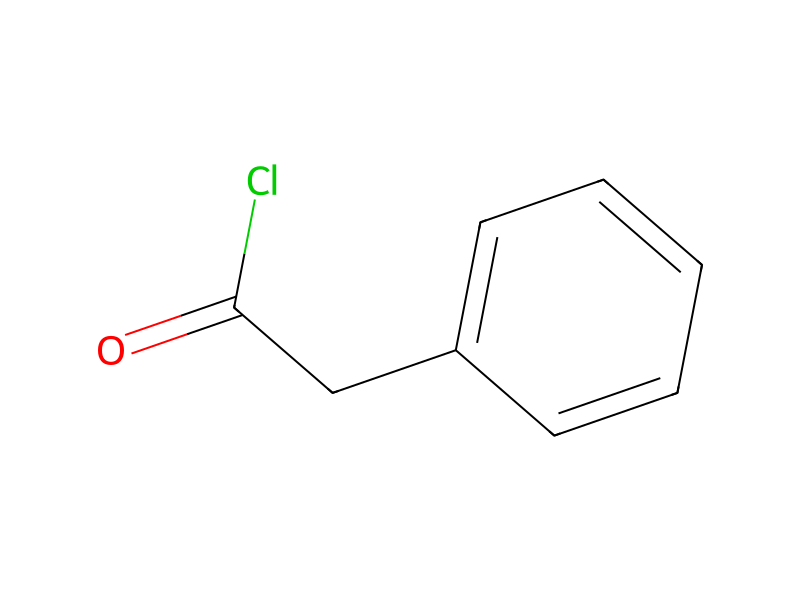





Conditions
- Temperature
- 0 °C
Procedure
Under an argon atmosphere, 2-amino-3-benzyl-5-(4-methoxyphenyl)pyrazine (c-11) (prepared by the method described in Adamczyk, M. et al., Org. Prep. Proced. Int., 33, 477-485 (2001)) (400 mg, 1.37 mmol) was dissolved in pyridine (4 mL) and to this was added 4-(dimethylamino)pyridine (17.3 mg, 142 μmol), and then cooled to 0° C. To this was added phenylacetyl chloride (540 μL, 4.08 mmol) and stirred for 3.5 h after warming to room temperature. To this was added saturated aqueous solution of sodium bicarbonate to stop the reaction and extracted 3 times with dichloromethane. The organic layer was washed with saturated aqueous solution of sodium sulfate and then dried over anhydrous sodium sulfate. After removing anhydrous sodium sulfate by filtration, the filtrate was concentrated under reduced pressure. The residue was purified by silica gel column chromatography (20 g, dichloromethane/ethyl acetate=15/1) to give 3-benzyl-5-(4-methoxyphenyl)-2-(phenylacetylamino)pyrazine (c-16) as a pale yellow solid (540 mg, 96.2%). Rf=0.25 (dichloromethane/ethyl acetate=15/1). Mp. 197.5-202° C. UV (MeOH) λmax (log ε) 330 (4.20), 293 (4.20), 274 (4.18). UV (pH 7.4 PB, 1% DMSO) λmax (log ε) 333.5 (3.73), 280.5 (3.85). 1H NMR (400 MHz, DMSO-d6) δ 3.68 (s, 2H), 3.81 (s, 3H), 4.03 (s, 2H), 7.01-7.08 (m, 4H), 7.11-7.24 (m, 3H), 7.24-7.30 (m, 1H), 7.32-7.38 (m, 4H), 8.01-8.06 (AA′BB′, 2H), 8.88 (s, 1H), 10.52 (s, 1H). 13C NMR (75.5 MHz, DMSO-d6/CD3OD=2/1) δ 40.2, 42.9, 55.5, 114.8 (2C), 126.7, 127.2, 128.4 (2C), 128.6, 128.7 (2C), 128.8 (2C), 129.4 (2C), 129.7 (2C), 136.0, 137.5, 138.7, 143.9, 149.0, 151.2, 161.3, 170.6. IR (KBr, cm−1) 706, 837, 1034, 1179, 1248, 1296, 1413, 1439, 1449, 1497, 1545, 1574, 1609, 1670, 3281, 3381. HRMS (FAB+) m/z 410.1876 (M+H, C26H24N3O2 requires 410.1869).
Workup
- temperatureafter warming to room temperature
- customthe reaction
- extractionextracted 3 times with dichloromethane
- washThe organic layer was washed with saturated aqueous solution of sodium sulfate
- dry with materialdried over anhydrous sodium sulfate
- customAfter removing anhydrous sodium sulfate
- filtrationby filtration
- concentrationthe filtrate was concentrated under reduced pressure
- customThe residue was purified by silica gel column chromatography (20 g, dichloromethane/ethyl acetate=15/1)
Sources & evidence
- ORD record
- ord-0310e40c63f041faaf04da9e7c75269d
- Source dataset
- uspto-grants-2013_04
- Patent number
- US08431525B2
Reaction notes
Loading…