Triphenylphosphine → HCID 59485912, compound
Reaction equation

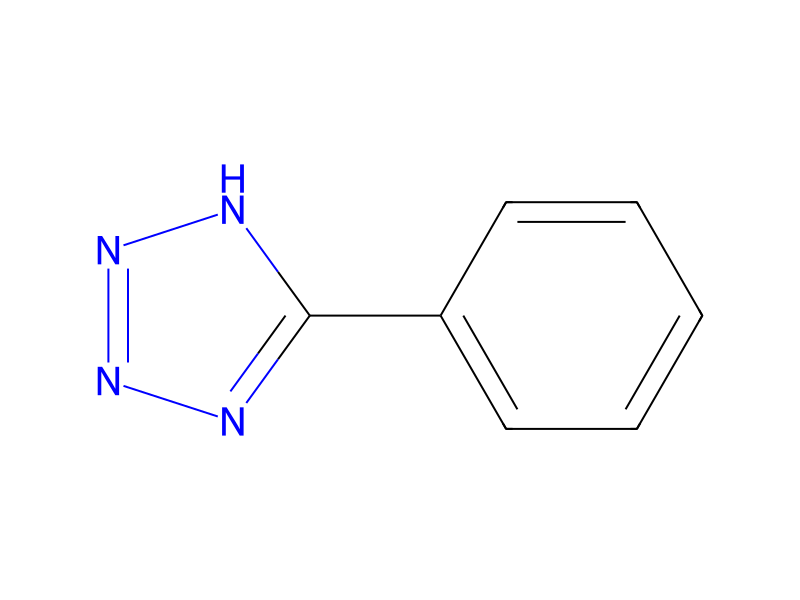
[Cl:1][C:2]1[CH:7]=[CH:6][C:5]([N:8]2[C@@H:12]([C:13]3[CH:18]=[CH:17][CH:16]=[C:15]([O:19][CH3:20])[CH:14]=3)[C@H:11]([CH2:21]O)[O:10][C:9]2=[O:23])=[CH:4][CH:3]=1.[C:24]1([C:30]2[NH:34][N:33]=[N:32][N:31]=2)[CH:29]=[CH:28][CH:27]=[CH:26][CH:25]=1.C1(P(C2C=CC=CC=2)C2C=CC=CC=2)C=CC=CC=1.CC(OC(/N=N/C(OC(C)C)=O)=O)C>C(Cl)Cl>[Cl:1][C:2]1[CH:3]=[CH:4][C:5]([N:8]2[C@@H:12]([C:13]3[CH:18]=[CH:17][CH:16]=[C:15]([O:19][CH3:20])[CH:14]=3)[C@H:11]([CH2:21][N:32]3[N:33]=[N:34][C:30]([C:24]4[CH:29]=[CH:28][CH:27]=[CH:26][CH:25]=4)=[N:31]3)[O:10][C:9]2=[O:23])=[CH:6][CH:7]=1Participants





Conditions
- Temperature
- 0 °C
Procedure
(4S,5R)-3-(4-Chlorophenyl)-5-(hydroxymethyl)-4-(3-methoxyphenyl)oxazolidin-2-one (40 mg, 0.12 mmol) and phenyltetrazole (17 mg, 0.12 mmol) are dissolved in DCM (1 mL), cooled to 0° C. and are then subsequently treated with triphenylphosphine (29 mg, 0.11 mmol) and diisopropylazodicarboxylate (0.024 mL, 0.12 mmol). The mixture is allowed to stir to room temperature overnight and is then purified by flash chromatography (4 g Redisep cartridge, 10-30% Ethyl acetate-hexanes) to give the title compound. 1H NMR (acetone-d6, 400 MHz) δ 8.05-8.03 (m, 2H), 7.54-7.50 (m, 3H), 7.47-7.43 (m, 2H), 7.32 (t, J=7.9 Hz, 1H), 7.30-7.24 (m, 2H), 7.09 (t, J=2.08 Hz, 1H), 7.05-7.03 (app d, J=7.8 Hz, 1H), 6.90 (ddd, J=8.3, 2.6, 0.9 Hz, 1H), 5.72 (d, J=5.1 Hz, 1H), 5.50 (dd, J=14.7, 8.7 Hz, 1H), 5.43 (dd, J=14.7, 10.6 Hz, 1H), 5.12-5.08 (m, 1H), 3.76 (s, 3H); HPLC-MS calculated C24H20ClN5O3 (M+H+) 462.1, found 462.1.
Workup
- customis then purified by flash chromatography (4 g Redisep cartridge, 10-30% Ethyl acetate-hexanes)
Sources & evidence
- ORD record
- ord-597cb75280ec486a9fe67faed51f46aa
- Source dataset
- uspto-grants-2013_04
- Patent number
- US08431607B2
Reaction notes
Loading…