Oxygen → Anthraquinone
Reaction equation

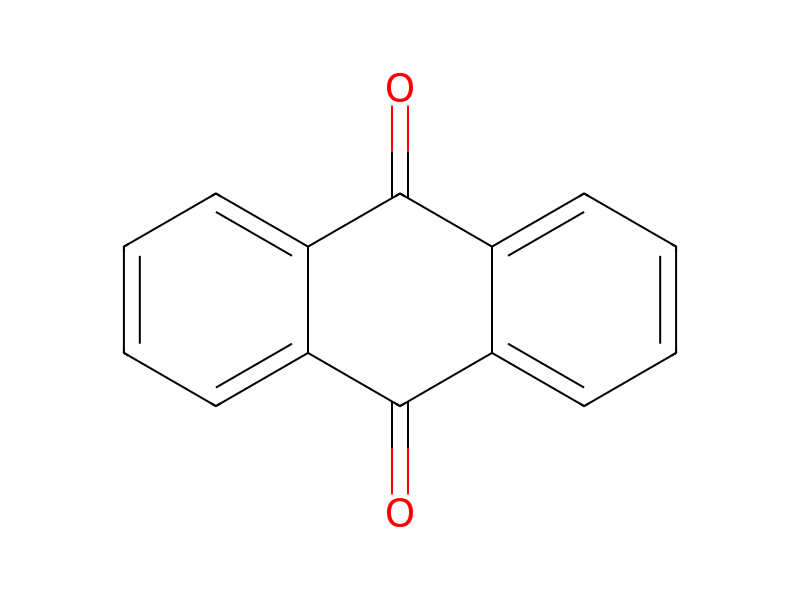
[CH:1]1[CH:2]=[CH:3][C:4]2[C:11](=[O:12])[CH:10]=[CH:9][C:7](=[O:8])[C:5]=2[CH:6]=1.C(O[CH:17]=[CH:18][CH:19]=[CH2:20])(=O)C.C([O-])(=O)C.[Na+].O=O>C(O)(=O)C.CN(C)C=O>[CH:17]1[C:10]2[C:11](=[O:12])[C:4]3[C:5](=[CH:6][CH:1]=[CH:2][CH:3]=3)[C:7](=[O:8])[C:9]=2[CH:20]=[CH:19][CH:18]=1Participants
7
Reactant 4



Product 1
Reagents, catalysts & solvents 2


Conditions
- Temperature
- 120 °C
Procedure
15.8 parts by weight naphthoquinone and 13.5 parts by weight of 1-acetoxybutadiene in 50 parts by volume of dimethylformamide and 1 part by volume of acetic acid are stirred for 6 hours under nitrogen at 45° - 50° C. 0.4 part by weight of sodium acetate is then added, oxygen is passed in and the batch is stirred for 2 hours at 120° C. After cooling, the anthraquinone which has precipitated is filtered off and washed with dimethylformamide. 18.2 parts by weight (91% of theory) of anthraquinone of melting point 284° C are obtained.
Workup
- temperatureAfter cooling
- customthe anthraquinone which has precipitated
- filtrationis filtered off
- washwashed with dimethylformamide
Sources & evidence
- ORD record
- ord-5f5ba06d4f464091ad634a72a246a7f6
- Source dataset
- uspto-grants-1976_12
- Patent number
- US03998857
Reaction notes
Loading…