Sodium hydride → HCID 19098832, compound
Reaction equation

[I-].[CH3:2][S+](C)(C)=O.[H-].[Na+].[F:9][C:10]1([F:24])[CH2:12][C:11]1([C:14]([CH2:16][C:17]1[CH:22]=[CH:21][C:20]([F:23])=[CH:19][CH:18]=1)=[O:15])[CH3:13]>CS(C)=O>[F:23][C:20]1[CH:19]=[CH:18][C:17]([CH2:16][C:14]2([C:11]3([CH3:13])[CH2:12][C:10]3([F:9])[F:24])[CH2:2][O:15]2)=[CH:22][CH:21]=1Participants
Reactant 3

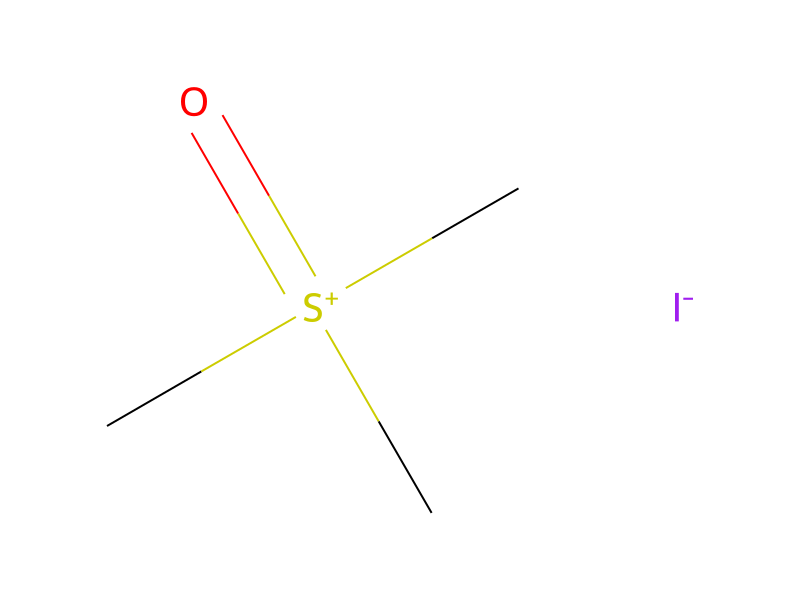

Product 1

Reagents, catalysts & solvents 1

Procedure
20 ml of absolute dimethyl sulphoxide are added dropwise to a mixture of 5.31 g (0.0241 mol) of trimethylsulphoxonium iodide and 0.79 g (0.0329 mol) of sodium hydride (80%) at 10° C. under a nitrogen atmosphere. When the addition is complete, the mixture is allowed to warm to room temperature in the course of 10 minutes, and a solution of 5 g (0.0219 mol) of 4-fluorobenzyl 2,2-difluoro-1-methyl-cyclopropyl ketone in 10 ml of absolute dimethyl sulphoxide is then added dropwise with stirring. Stirring is continued for 4 hours at 40° C. The reaction mixture is then poured onto ice-water. The mixture which forms is extracted three times using cyclohexane. The combined organic phases are dried over sodium sulphate and concentrated under reduced pressure. In this manner, 6.3 g of 2-(4-fluoro-benzyl)-2-(2,2-difluoro-1-methyl-cyclopropyl)-oxirane are obtained, which is used for further reaction without additional purification. ##STR31##
Workup
- additionWhen the addition
- stirringStirring
- additionThe reaction mixture is then poured onto ice-water
- extractionThe mixture which forms is extracted three times
- dry with materialThe combined organic phases are dried over sodium sulphate
- concentrationconcentrated under reduced pressure
Sources & evidence
- ORD record
- ord-5904eef2b5d34caba4e2a71fe4cb968a
- Source dataset
- uspto-grants-1994_02
- Patent number
- US05288883
Reaction notes
Loading…