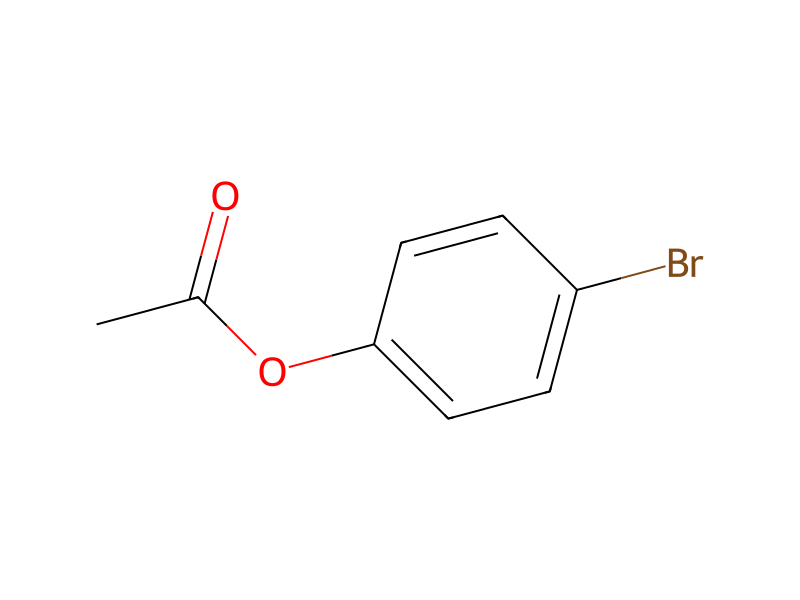
Acetyl chloride → Phenol, 4-bromo-, 1-acetate
Reaction equation

[Br:1][C:2]1[CH:7]=[CH:6][C:5]([OH:8])=[CH:4][CH:3]=1.C(=O)([O-])[O-].[K+].[K+].[C:15](Cl)(=[O:17])[CH3:16]>C(#N)C>[C:15]([O:8][C:5]1[CH:6]=[CH:7][C:2]([Br:1])=[CH:3][CH:4]=1)(=[O:17])[CH3:16]Participants
5
Reactant 3



Product 1
Reagents, catalysts & solvents 1

Procedure
To a solution of 10.0 g (57.8 mmol) of 4-bromophenol in 100 mL of acetonitrile was added 9.6 g (69.5 mmol) of potassium carbonate. A white slurry was obtained to which was added 8.6 mL (121.0 mmol) of acetyl chloride and the resultant reaction mixture was stirred at ambient temperature for 17.5 hours. The reaction mixture was filtered, washed with ethyl acetate and the filtrate was concentrated in vacuo to a yellow oil. Purification by flash chromatography (silica, 10% ethyl acetate in hexane) gave the title compound as a clear, nearly colorless oil.
Workup
- customA white slurry was obtained to which
- customthe resultant reaction mixture
- filtrationThe reaction mixture was filtered
- washwashed with ethyl acetate
- concentrationthe filtrate was concentrated in vacuo to a yellow oil
- customPurification by flash chromatography (silica, 10% ethyl acetate in hexane)
Sources & evidence
- ORD record
- ord-2957478e275a418fbe815edb492b30d7
- Source dataset
- uspto-grants-2001_05
- Patent number
- US06225494B1
Reaction notes
Loading…