Tetrahydrofuran → 2,6-Di-tert-butyl-4-[(2-methylcyclopenta-1,3-dien-1-yl)methyl]phenol
Reaction equation

[CH3:1][C:2]1[CH2:6][CH:5]=[CH:4][CH:3]=1.[C:7]([C:11]1[CH:16]=[C:15](N(C)C)[CH:14]=[C:13]([C:20]([CH3:23])([CH3:22])[CH3:21])[C:12]=1[OH:24])([CH3:10])([CH3:9])[CH3:8].O1CCC[CH2:26]1.[Na]>O>[CH3:1][C:2]1[CH:6]=[CH:5][CH2:4][C:3]=1[CH2:26][C:15]1[CH:16]=[C:11]([C:7]([CH3:10])([CH3:9])[CH3:8])[C:12]([OH:24])=[C:13]([C:20]([CH3:23])([CH3:22])[CH3:21])[CH:14]=1Participants

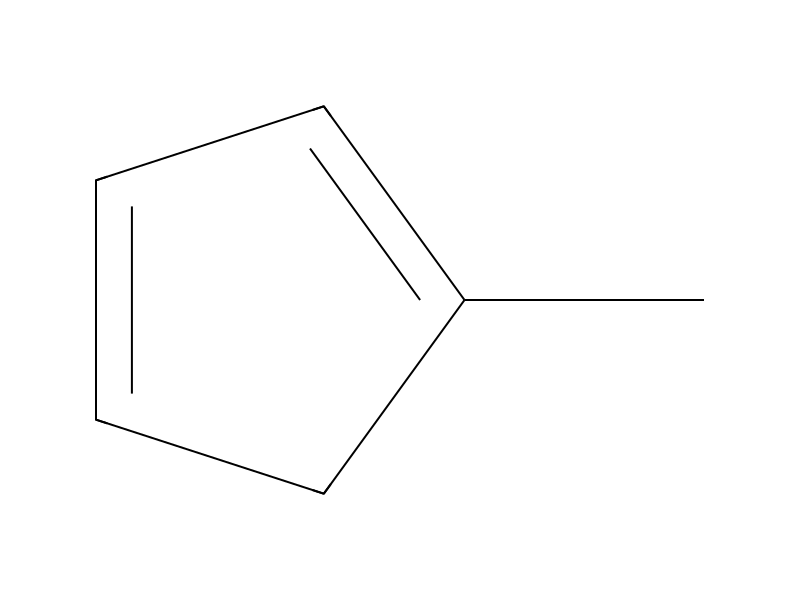




Conditions
- Temperature
- 70 °C
Procedure
To a stirred mixture of 40 g (0.5 m) methylcyclopentadiene, 39.5 g (0.15 m) 2,6-di-t-butyl-4-dimethylaminophenol and 100 ml of tetrahydrofuran was slowly added 6.0 g (0.26 m) of sodium. The temperature was raised to 70° C. and the mixture allowed to react for 20 hours. A gas chromatograph showed that all of the 2,6-di-t-butyl-4-dimethylaminophenol had reacted. The mixture was diluted with water, extracted with toluene and rotovaped to remove the toluene and leave 38 g of crude product. A 90% yield, 31.5 g, of pure product methyl-(3,5-di-tert-butyl-4-hydroxybenzyl)cyclopentadiene was obtained by distillation, b.p. 155° to 160° C. at 1.5 mm as a viscous yellow oil. After standing at room temperature for 2 weeks, the material was analyzed by mass spectral analysis and by gas chromatography. Both showed that the product and its dimer were present. The mass spectrum showed a 3 to 1 ratio of the monomer to dimer, m/e 298 and m/e 596, respectively. The gas chromatograph showed a sharp peak for the monomer followed by the broad peak due to the slow decomposition of the dimer.
Workup
- customto react for 20 hours
- customhad reacted
- extractionextracted with toluene
- customto remove the toluene
- customleave 38 g of crude product
Sources & evidence
- ORD record
- ord-8ced1c6af419476180317c692fb3b1f0
- Source dataset
- uspto-grants-1984_11
- Patent number
- US04484010
Reaction notes
Loading…