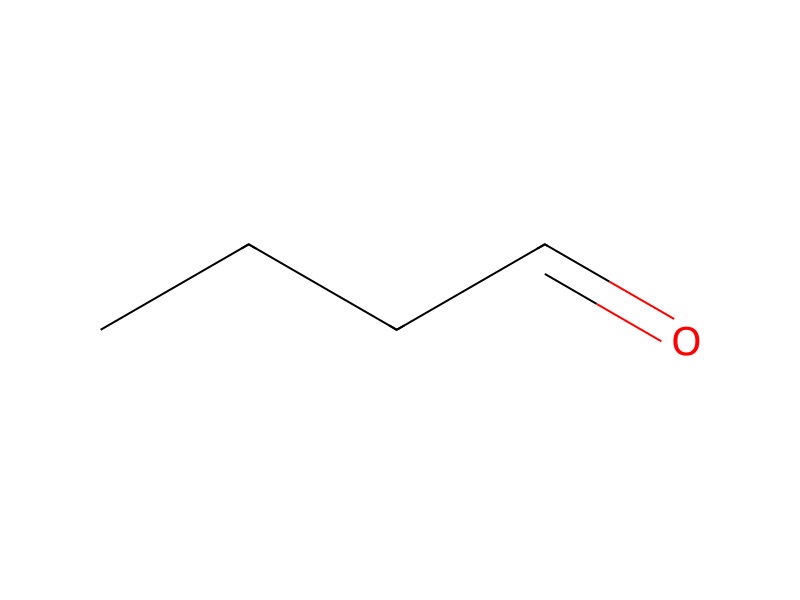
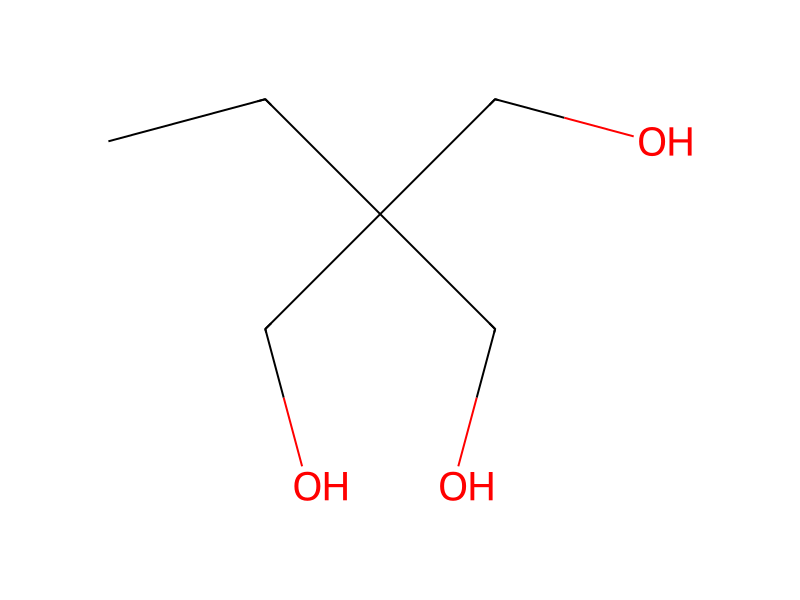
Butanal → Trimethylolpropane
Reaction equation

[CH:1](=[O:5])[CH2:2][CH2:3][CH3:4].[CH2:6](N(CC)CC)C.[CH2:13]=[O:14].[OH2:15]>>[CH2:13]([C:2]([CH2:1][OH:5])([CH2:6][OH:15])[CH2:3][CH3:4])[OH:14]Participants



Conditions
- Temperature
- 70 °C
Procedure
216 g (3 moles) of n-butyraldehyde are added dropwise to a mixture of 450 g (4.5 moles) of triethylamine, 1,200 g of 30% strength formalin solution (12 moles of formaldehyde) and 1,000 g of water in the course of 45 minutes, after which the solution is heated at 70° C. for 4 hours. Water, triethylamine and triethylammonium formate are distilled off under reduced pressure as described in Example 1, and the residue is then diluted with four times its weight of water and hydrogenated at 100° C. and under 100 bar, in the presence of 24 g of 10% strength Pd/carbon, in an autoclave. The absorption of hydrogen is complete after 3 hours. The catalyst is filtered off and the low boilers are separated off by distillation, after which 334 g (83% yield) of trimethylolpropane of boiling point 153° C./3 mbar and 26 g (7% yield) of di-trimethylolpropane of boiling point 185° C./3 mbar are isolated by distillation under 3 mbar, the stated % yields being based on n-butyraldehyde.
Workup
- distillationWater, triethylamine and triethylammonium formate are distilled off under reduced pressure
- additionthe residue is then diluted with four times its weight of water and hydrogenated at 100° C. and under 100 bar, in the presence of 24 g of 10% strength Pd/carbon, in an autoclave
- customThe absorption of hydrogen
- filtrationThe catalyst is filtered off
- customthe low boilers are separated off by distillation
Sources & evidence
- ORD record
- ord-7de892f43cac4a98909fda1b33cf98f4
- Source dataset
- uspto-grants-1986_06
- Patent number
- US04594461
Reaction notes
Loading…