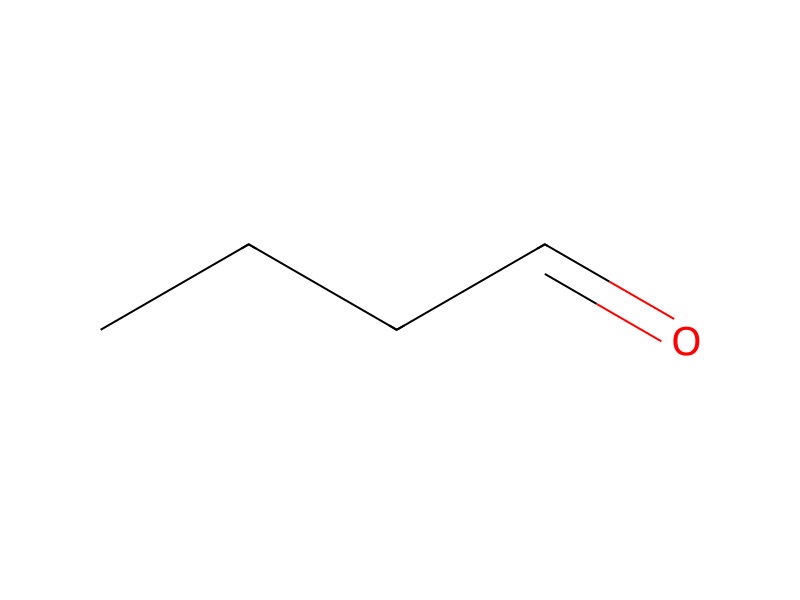
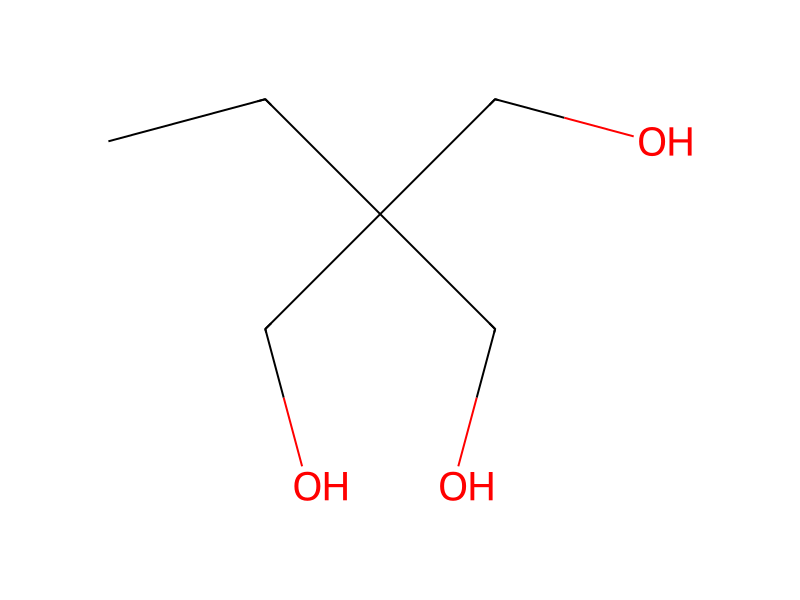
Butanal → Trimethylolpropane
Reaction equation

C(N(CC)CC)C.[CH:8](=[O:12])[CH2:9][CH2:10][CH3:11].[CH2:13]=[O:14].[CH:15]([O-:17])=O.C([NH+](CC)CC)C>>[CH2:8]([C:9]([CH2:15][OH:17])([CH2:13][OH:14])[CH2:10][CH3:11])[OH:12]Participants



Procedure
98.7 ml (0.71 mole)/hour of triethylamine, 42.9 ml (0.49 mole)/hour of n-butyraldehyde and 308.7 ml/hour of 15.2% strength formaldehyde solution (1.7 moles/hour of formaldehyde) are passed into a continuous reaction cascade which consists of three flasks connected in series, the reaction volume of each flask being 900 ml and the reaction temperature in each flask being 80° C. The reacted mixture from the cascade is fed to a continuous hydrogenation apparatus and is hydrogenated at 115° C. and under 60 bar, the catalyst consisting of 81.47% of NiO and 18.53% of Al2O3. Low boilers, and triethylammonium formate formed in the course of the reaction, are then separated off by distillation under reduced pressure (20 mbar). Fractional distillation of the residue under 3 mbar gives 125 g (84% yield) of trimethylolpropane per of hydrogenated mixture and 18 g (13% yield) of di-trimethylolpropane per of hydrogenated mixture, the stated % yields being based on n-butyraldehyde.
Workup
- customthe reaction volume of each flask being
- custom900 ml and the reaction temperature in each flask being 80° C
- customis hydrogenated at 115° C. and under 60 bar
- customare then separated off by distillation under reduced pressure (20 mbar)
- distillationFractional distillation of the residue under 3 mbar
Sources & evidence
- ORD record
- ord-699c936dd83f4aea8e2e8e0340fb3b32
- Source dataset
- uspto-grants-1986_06
- Patent number
- US04594461
Reaction notes
Loading…