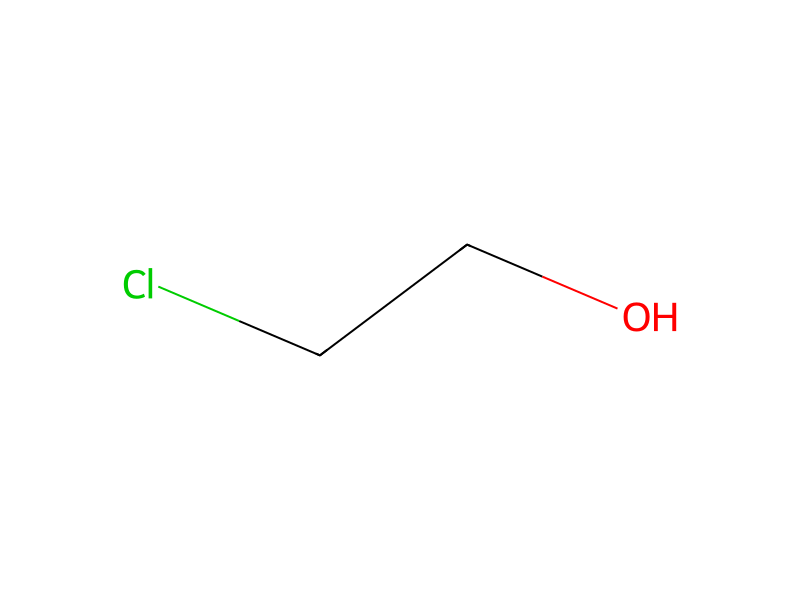
2-Chloroethanol → 4-(2-chloroethoxy)-1H-indole
Reaction equation

[OH:1][C:2]1[CH:10]=[CH:9][CH:8]=[C:7]2[C:3]=1[CH:4]=[CH:5][NH:6]2.[Cl:11][CH2:12][CH2:13]O.C1(P(C2C=CC=CC=2)C2C=CC=CC=2)C=CC=CC=1.N(C(OCC)=O)=NC(OCC)=O>O1CCCC1.CCOCC.CCCCCC.C(OCC)C>[Cl:11][CH2:12][CH2:13][O:1][C:2]1[CH:10]=[CH:9][CH:8]=[C:7]2[C:3]=1[CH:4]=[CH:5][NH:6]2Participants
8
Reactant 4



Product 1

Reagents, catalysts & solvents 3


Procedure
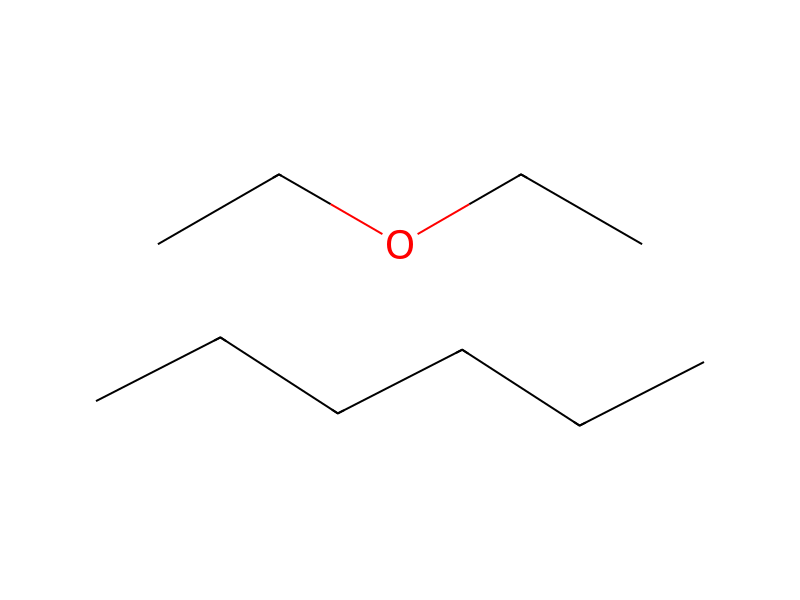
A solution of 4-hydroxyindole (3.99 g, 30 mmol), 2-chloroethanol (6.03 ml, 90 mmol) and triphenylphosphine (23.6 g, 90 mmol) in tetrahydrofuran is treated with diethyl azodicarboxylate (14.1 ml, 90 mmol) under nitrogen at room temperature, stirred for 2 hr at room temperature and concentrated in vacuo to give a residue. Cooled diethyl ether is added to the residue and the solid triphenylphosphine oxide is precipitated and removed by filtration. The filtrate is concentrated and purified by flash chromatography (silica gel, EtOAc/hexane: 1.5/8.5) to give an oil. After trituration with Et2O/hexane (1/10), the title compound is obtained as a white solid, 4.8 g (82%) mp 60° C., identified by NMR and mass spectral analyses.
Workup
- concentrationconcentrated in vacuo
- customto give a residue
- customthe solid triphenylphosphine oxide is precipitated
- customremoved by filtration
- concentrationThe filtrate is concentrated
- custompurified by flash chromatography (silica gel, EtOAc/hexane: 1.5/8.5)
- customto give an oil
Sources & evidence
- ORD record
- ord-798f6d5e70634ddeb5af4a44549c741d
- Source dataset
- uspto-grants-2009_06
- Patent number
- US07541358B2
Reaction notes
Loading…