2,3-Dichloro-5,6-dicyano-1,4-benzoquinone → 1H-Pyrrolo[2,3-b]pyridine-5-carboxylic acid
Reaction equation

C([Si](C)(C)[N:6]1[C:10]2=[N:11][CH:12]=[C:13]([C:15]([OH:17])=[O:16])[CH:14]=[C:9]2[CH2:8][CH2:7]1)(C)(C)C.C(C1C(=O)C(Cl)=C(Cl)C(=O)C=1C#N)#N.N1C2C(=CC=CC=2)C=N1>C(Cl)Cl.Cl.CO>[NH:6]1[C:10]2=[N:11][CH:12]=[C:13]([C:15]([OH:17])=[O:16])[CH:14]=[C:9]2[CH:8]=[CH:7]1Participants
Reactant 3

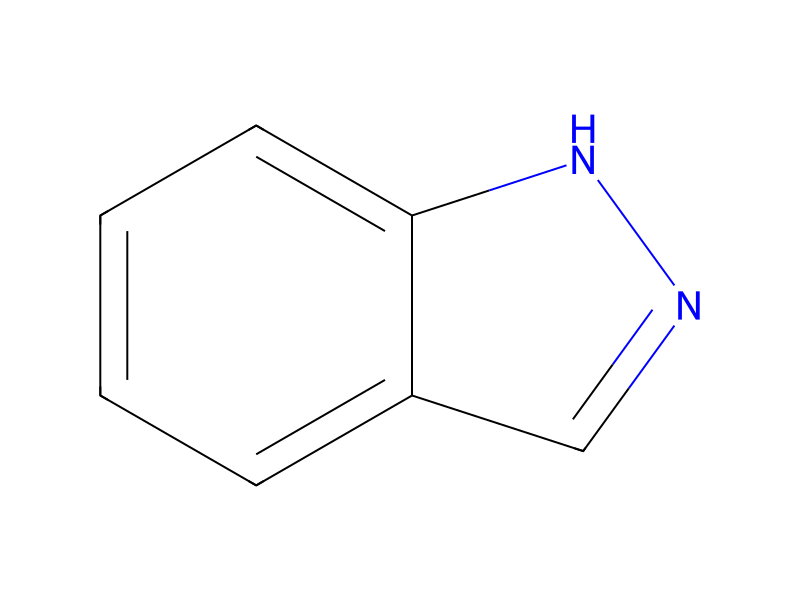

Product 1

Reagents, catalysts & solvents 3



Procedure
A solution of crude acid 10 in CH2Cl2 (5 mL) was treated with DDQ in small portions until TLC analysis revealed no starting material left. The mixture was concentrated to afford a solid residue containing azaindole 11. The residue was dissolved in a 5% solution of HCl in MeOH (5 mL), and stirred at r.t. After 1.5 h the mixture was concentrated and diluted with CHCl3 and saturated brine. The mixture was basified with 50% NaOH solution to pH 11. The organic layer was discarded. The aqueous layer was neutralized with 6 M HCl and extracted with AcOEt (4×). The combined organic extracts were dried (MgSO4), filtered and concentrated. The residue was purified by PTLC using CH2Cl2:MeOH=9:1 as eluent to afford acid 12 (3.19 mg, 3% over 3 steps). 1H NMR (400 MHz; CD3OD) δ 6.58 (d, J=3.5 Hz, 1H), 7.42 (d, J=3.5 Hz, 1H), 8.58 (d, J=2.0 Hz, 1H), 8.85 (d, J=1.7 Hz, 1H).
Workup
- waitleft
- concentrationThe mixture was concentrated
- customto afford a solid residue
- concentrationAfter 1.5 h the mixture was concentrated
- additiondiluted with CHCl3 and saturated brine
- extractionextracted with AcOEt (4×)
- dry with materialThe combined organic extracts were dried (MgSO4)
- filtrationfiltered
- concentrationconcentrated
- customThe residue was purified by PTLC
Sources & evidence
- ORD record
- ord-ef99ec69025f486d8fa5ca9033aa579b
- Source dataset
- uspto-grants-2010_01
- Patent number
- US07652137B2
Reaction notes
Loading…