Trichloroacetyl chloride → 2-(Trichloroacetyl)pyrrole
Reaction equation

[Cl:1][C:2]([Cl:7])([Cl:6])[C:3](Cl)=[O:4].[NH:8]1[CH:12]=[CH:11][CH:10]=[CH:9]1.C(=O)([O-])[O-].[Na+].[Na+]>CCOCC.O>[Cl:1][C:2]([Cl:7])([Cl:6])[C:3]([C:9]1[NH:8][CH:12]=[CH:11][CH:10]=1)=[O:4]Participants
Reactant 3

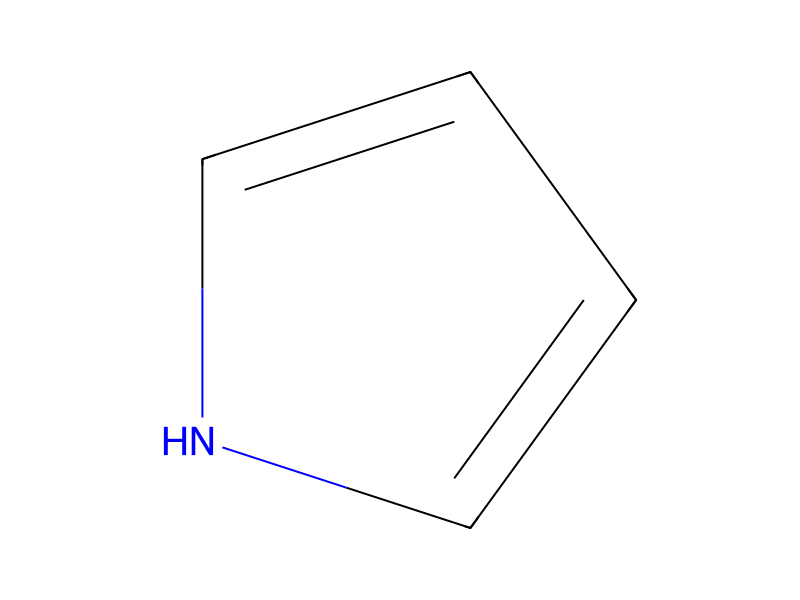

Product 1
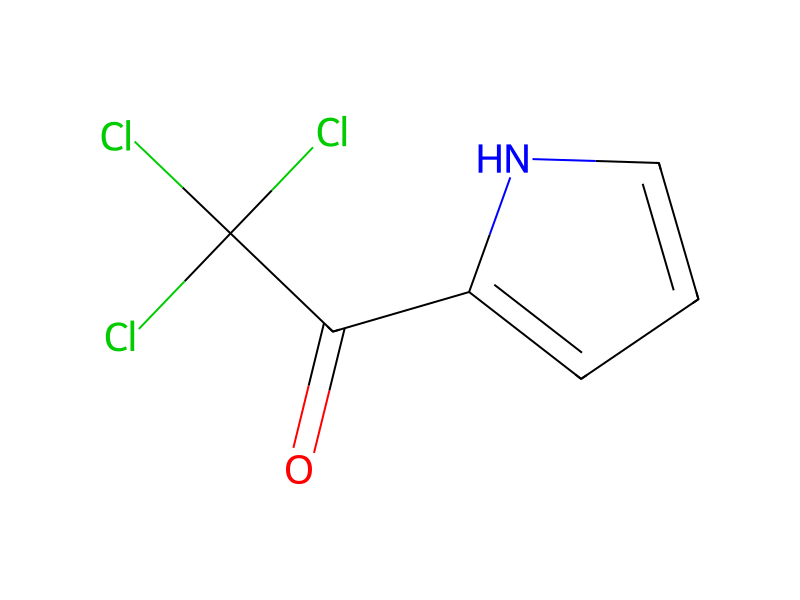
Reagents, catalysts & solvents 2


Procedure
To trichloroacetyl chloride (48 mL; 0.43 mol) taken in anhydrous ether (150 mL) under nitrogen was added pyrrole (25 g, 0.37 mol) dissolved in anhydrous ether (500 mL) through a dropping funnel over a 2-hour period. The violet ether solution began to reflux during addition. Refluxing was continued for 1 h before the reaction was quenched with a solution of sodium carbonate (33 g, 0.31 mol) in water (200 mL). The layers were separated and the red organic layer was washed four times with water (4×50 mL) and once with brine (1×50 mL) and finally dried over anhydrous sodium sulphate. The red ether solution was then filtered through CELITE® and washed with ether. The solvent was removed under vacuum to afford 2-trichloroacetylpyrrole (Example 1A, 72 g, 91% yield).) as an ash colored solid (72 g, 91% yield). LC-MS, [M−H]+=212. 1H NMR (DMSO-d6, 300 MHz): δ 9.63 (brs, 1H), 7.39 (m, 1H), 7.19 (m, 1H), 6.40 (m, 1H).
Workup
- temperatureto reflux during addition
- temperatureRefluxing
- customThe layers were separated
- washthe red organic layer was washed four times with water (4×50 mL)
- dry with materialonce with brine (1×50 mL) and finally dried over anhydrous sodium sulphate
- filtrationThe red ether solution was then filtered through CELITE®
- washwashed with ether
- customThe solvent was removed under vacuum
Sources & evidence
- ORD record
- ord-e807f0ee5eb24b17ac1ff00a65f02735
- Source dataset
- uspto-grants-2013_11
- Patent number
- US08580959B2
Reaction notes
Loading…