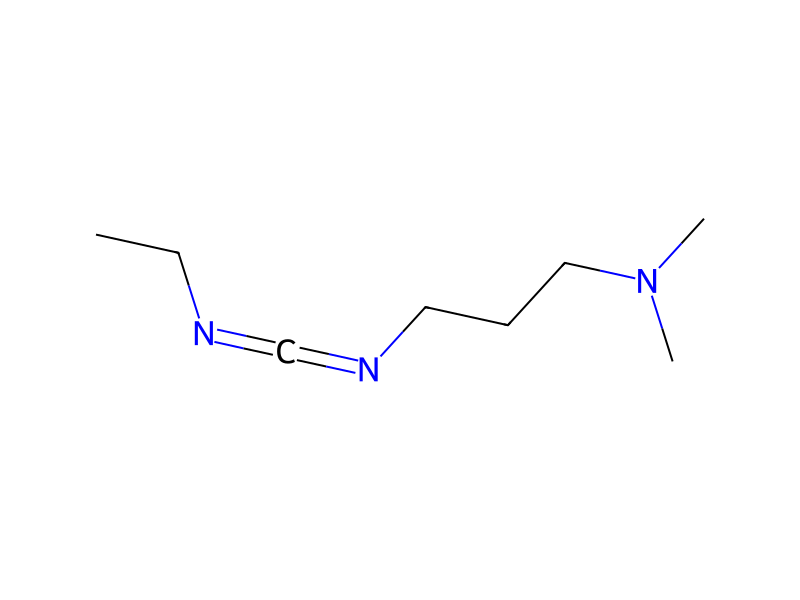
4-Methylmorpholine → HCID 67995913, compound
Reaction equation

[S:1]1[C:5]([C:6](O)=O)=[CH:4][N:3]=[CH:2]1.CCN=C=NCCCN(C)C.C1C=CC2N(O)[N:27]=[N:26][C:24]=2C=1.CN1CCOCC1.COC1C=CC(P2(SP(C3C=CC(OC)=CC=3)(=S)S2)=[S:46])=CC=1>>[S:46]1[CH:24]=[N:26][N:27]=[C:6]1[C:5]1[S:1][CH:2]=[N:3][CH:4]=1Participants




Procedure
The ester or 1,3,4-thiadiazole substituted thiazoles at ring B may be prepared as shown in Scheme 12. Typical conversion of the carboxylic acid 55 to amide functionality via acyl chloride and the following thionation using Lawesson's reagent produce the corresponding thioamide, which is treated with ethyl 2-chloro-2-formylacetate and pyridine in refluxed ethanol to provide the corresponding thiazole-5-carboxylic acid 56 in 35% over four steps. The ester 56 is hydrolysed under basic conditions to generate the corresponding acid. Next, this acid is coupled with formyl hydrazide under conditions of EDCI, HOBt, and NMM. Following cyclization using Lawesson's reagent produced 5-(1,3,4-thiadiazol-2-yl)-thiazole 57 in 44% yield for the four steps.
Sources & evidence
- ORD record
- ord-ae798df560394740adb261f0fb096eac
- Source dataset
- uspto-grants-2013_11
- Patent number
- US08586550B2
Reaction notes
Loading…