Trityl chloride → (s)-2-(Tritylamino)butan-1-ol
Reaction equation

[NH2:1][C@@H:2]([CH2:5][CH3:6])[CH2:3][OH:4].C(N(C(C)C)CC)(C)C.[C:16](Cl)([C:29]1[CH:34]=[CH:33][CH:32]=[CH:31][CH:30]=1)([C:23]1[CH:28]=[CH:27][CH:26]=[CH:25][CH:24]=1)[C:17]1[CH:22]=[CH:21][CH:20]=[CH:19][CH:18]=1.CCCCCC>ClCCl.CO.CCOCC>[C:16]([NH:1][C@@H:2]([CH2:5][CH3:6])[CH2:3][OH:4])([C:17]1[CH:22]=[CH:21][CH:20]=[CH:19][CH:18]=1)([C:29]1[CH:30]=[CH:31][CH:32]=[CH:33][CH:34]=1)[C:23]1[CH:24]=[CH:25][CH:26]=[CH:27][CH:28]=1Participants
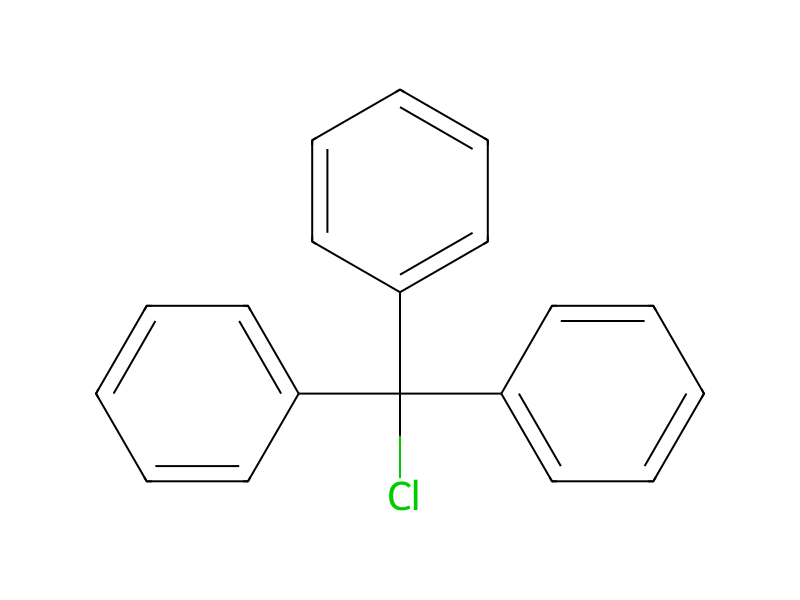







Procedure
To a stirred solution of (S)-(+)-2-aminobutan-1-ol (10 g, 112.18 mmol) in dichloromethane (DCM, 250 ml) under an argon atmosphere at room temperature, was added diisopropylethylamine (DIEA, 19.4 ml, 112.18 mmol) followed by trityl chloride (31.2 g, 112.18 mmol). The reaction mixture was stirred at this temperature for 48 h, when TLC (hexane:ether:MeOH; 55:40:5) indicated that the reaction had gone to completion. The solvent was evaporated in vacuo and the residue taken up in ethyl acetate. The organic solution was washed with water (2×), dried over sodium sulphate. The solvent was removed to afford (S)-2-(trityl-amino)-butan-1-ol as a light yellow oil; Yield: 33 g (89%). 1H-NMR (CDCl3, 250 MHz): δ 0.72 (3 H, t, J=7.5 Hz, —NHCH(CH2CH3)CH2OH), 1.15-1.10 (m, 2H, —NHCH(CH2CH3)CH2OH), 2.05 (1 H, s, br, NH), 2.24 (1 H, s, br, OH), 2.62-2.54 (m, 1H, —NHCH(CH2CH3)CH2OH), 3.17-3.08 (1 H m, —NHCH(CH2CH3)CHHOH), 3.35-3.29 (1 H, m, NHCH(CH2CH3)CHHOH), 7.37-7.2 (12H, m, ArH), 7.65-7.58 (3 H, m, ArH); δC (250 MHz, CDCl3) 146.86 (C), 129.43 (6×CH), 127.90 (6×CH), 126.48 (3×CH), 71.27 (C), 62.72 (CH2), 48.91 (CH), 24.55 (CH2), 10.47 (CH3)
Workup
- customThe solvent was evaporated in vacuo
- washThe organic solution was washed with water (2×)
- dry with materialdried over sodium sulphate
- customThe solvent was removed
Sources & evidence
- ORD record
- ord-c59470d3513a4e78bf67604790fb459c
- Source dataset
- uspto-grants-2013_11
- Patent number
- US08592581B2
Reaction notes
Loading…