Formaldehyde → HCID 12782916, compound
Reaction equation

C(NC(C)C)(C)C.C([Li])CCC.CCCCCC.CN(C)P(N(C)C)(N(C)C)=O.[C:30]([OH:47])(=[O:46])[CH2:31][CH2:32][CH2:33][CH2:34][CH2:35][CH2:36][CH2:37][CH2:38][CH2:39][CH2:40][CH2:41][CH2:42][CH2:43][CH2:44][CH3:45].C=O.[C:50]([O-])(=[O:66])CCCCCCCCCCCCCCC.[Li+]>O1CCCC1>[OH:66][CH2:50][CH:31]([CH2:32][CH2:33][CH2:34][CH2:35][CH2:36][CH2:37][CH2:38][CH2:39][CH2:40][CH2:41][CH2:42][CH2:43][CH2:44][CH3:45])[C:30]([OH:47])=[O:46]Participants
Reactant 7

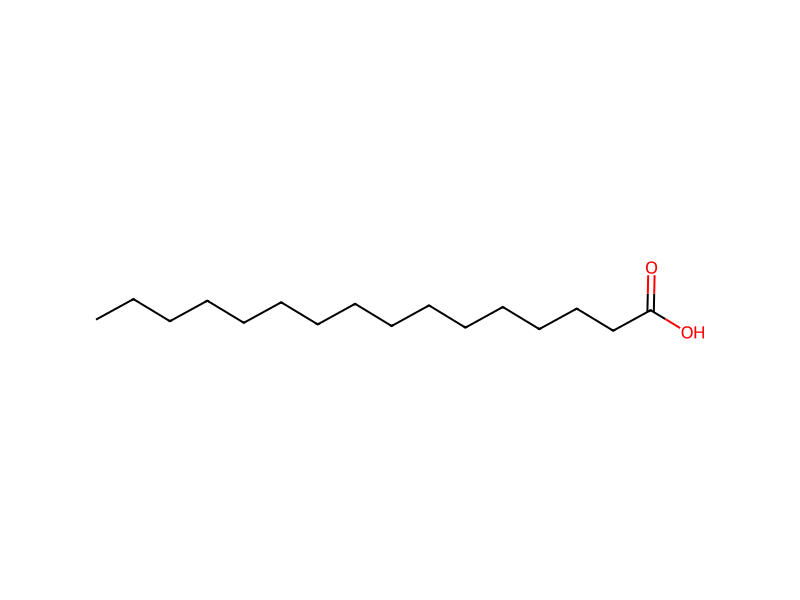





Product 1

Reagents, catalysts & solvents 1

Procedure
Anhydrous tetrahydofuran (THF) (825 ml) and 49.5 g (0.49 mole) of diisopropylamine were added to a dry three neck flask purged with nitrogen and maintained under a nitrogen atmosphere. After cooling the mixture to -20°, 300 ml of n-butyllithium in hexane (1.6 M) (0.49 mole) was added slowly to prevent the temperature from exceeding 0° and then 79.3 ml of anhydrous hexamethylphosphoramide (HMPA) (0.44 mole) was added. A solution of 51.28 g of palmitic acid (0.198 mole) in 400 ml of THF was added dropwise with stirring while maintaining the reaction temperature below 0°. A milky white suspension resulted after the addition of palmitic acid. The reaction mixture was brought to about 40° by using a warm water bath. The suspension changed to a clear solution as the temperature gradually reached 40°. This system was then connected to a formaldehyde generating system. Paraformaldehyde (40 g) was heated in a three neck flask at 180°-200° to generate formaldehyde and the formaldehyde vapors were carried by a stream of nitrogen over the surface of the stirred solution of α-lithiated lithium palmitate prepared previously. The reaction was terminated after complete depolymerization of paraformaldehyde (2 to 21/2 hrs.). The reaction solution was cooled in an ice bath and neutralized with hydrochloric acid until acidic. The organic layer was separated and was concentrated under reduced pressure on a rotavac to remove most of the THF solvent. The resulting oily residue was dissolved in 2 liters of ether and was washed three times with 10% hydrochloric acid solution and then twice with water. The ether layer was dried over Na2SO4 and the solvents were removed under reduced pressure to give 43.3 g (75%) of crude product, α-hydroxymethylpalmitic acid, which was recrystallized once from acetone to give 39.0 g (69% yield) of the product with m.p. 67°-71°, which was used without further purification in the next synthetic step.
Workup
- customa dry three neck flask
- custompurged with nitrogen
- temperaturemaintained under a nitrogen atmosphere
- temperatureAfter cooling the mixture to -20°
- customfrom exceeding 0°
- temperaturewhile maintaining the reaction temperature below 0°
- customA milky white suspension resulted
- customwas brought to about 40°
- customchanged to a clear solution as the temperature gradually reached 40°
- customprepared previously
- customThe reaction was terminated after complete depolymerization of paraformaldehyde (2 to 21/2 hrs.)
- temperatureThe reaction solution was cooled in an ice bath
- customThe organic layer was separated
- concentrationwas concentrated under reduced pressure on a rotavac
- customto remove most of the THF solvent
- dissolutionThe resulting oily residue was dissolved in 2 liters of ether
- washwas washed three times with 10% hydrochloric acid solution
- dry with materialThe ether layer was dried over Na2SO4
- customthe solvents were removed under reduced pressure
- customto give 43.3 g (75%) of crude product, α-hydroxymethylpalmitic acid, which
- customwas recrystallized once from acetone
Sources & evidence
- ORD record
- ord-5e3ead8311a846fe80d8a6b8d19b3c63
- Source dataset
- uspto-grants-1980_04
- Patent number
- US04196300
Reaction notes
Loading…