Dimethylcarbamoyl Chloride → Urea, 3-(2-benzothiazolyl)-1,1-dimethyl-
Reaction equation

[NH2:1][C:2]1[S:3][C:4]2[CH:10]=[CH:9][CH:8]=[CH:7][C:5]=2[N:6]=1.[CH3:11][N:12]([CH3:16])[C:13](Cl)=[O:14].[Cl-].[Al+3].[Cl-].[Cl-]>ClC=C(Cl)Cl>[CH3:11][N:12]([CH3:16])[C:13]([NH:1][C:2]1[S:3][C:4]2[CH:10]=[CH:9][CH:8]=[CH:7][C:5]=2[N:6]=1)=[O:14]Participants
5
Reactant 3
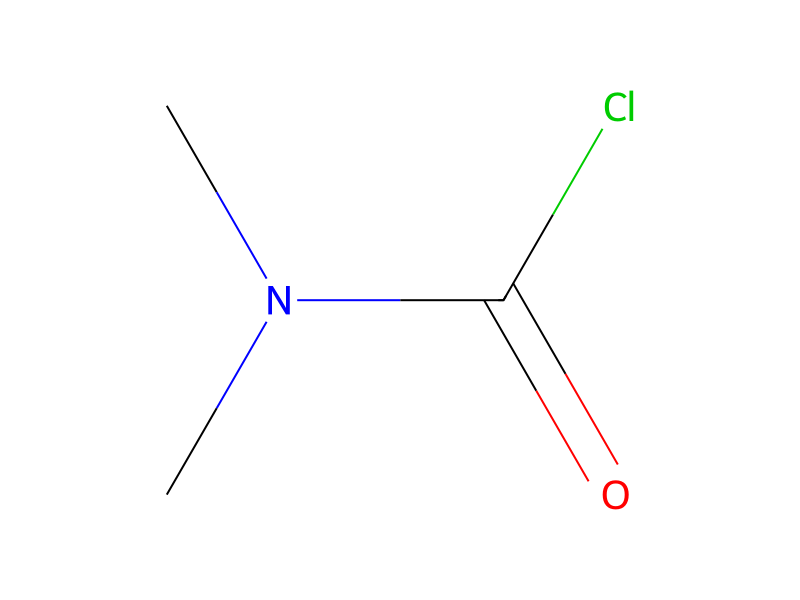


Product 1

Reagents, catalysts & solvents 1

Procedure
Using 2-aminobenzothiazole (1.50 g), N,N-dimethylcarbamoyl chloride (1.29 g), aluminum chloride (1.60 g), and trichloroethylene (40 ml), the reaction is effected as in Example 1, except that the reflux is carried out for 40 hours. Thus, 1,1-dimethyl-3-(2-benzothiazolyl)urea (2.16 g) is obtained. Yield is 97.7%. Melting point is higher than 300° C. (after recrystallization from ethanol).
Sources & evidence
- ORD record
- ord-b1da622f11aa4dbd85fc654d4a51ced1
- Source dataset
- uspto-grants-1980_01
- Patent number
- US04183856
Reaction notes
Loading…