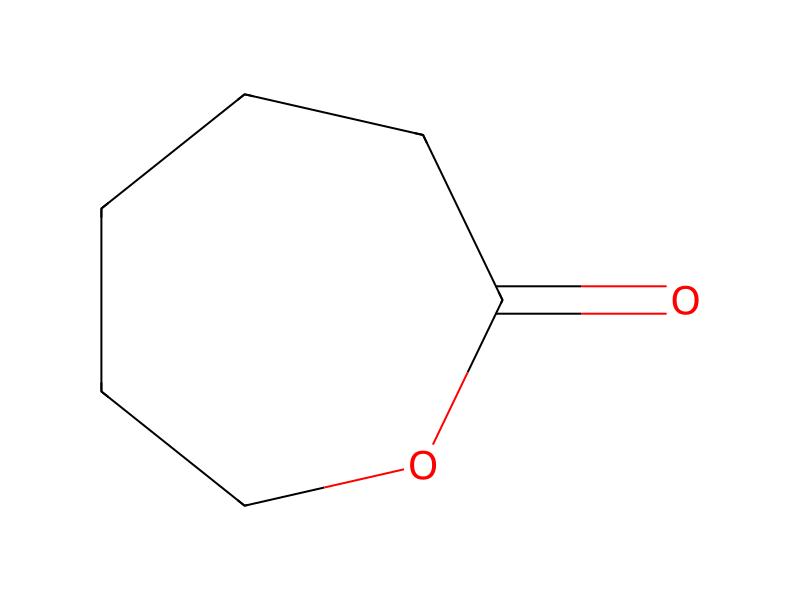
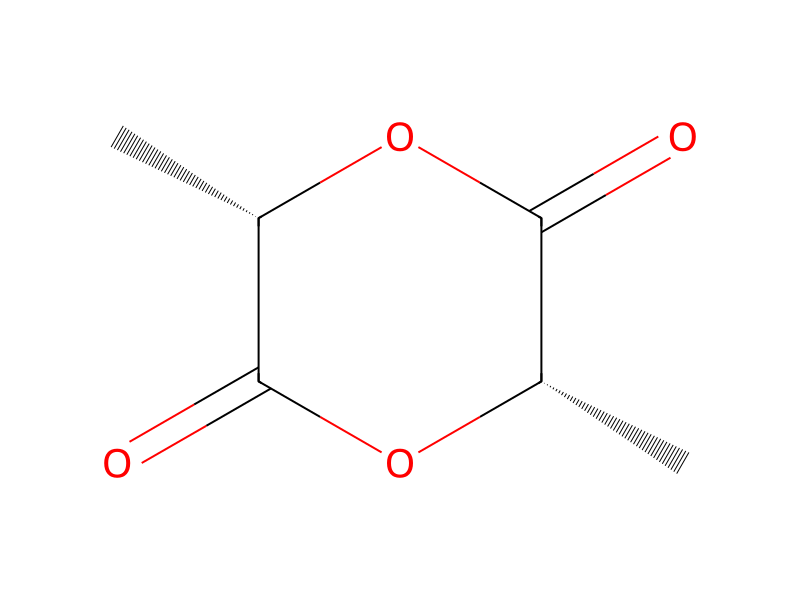
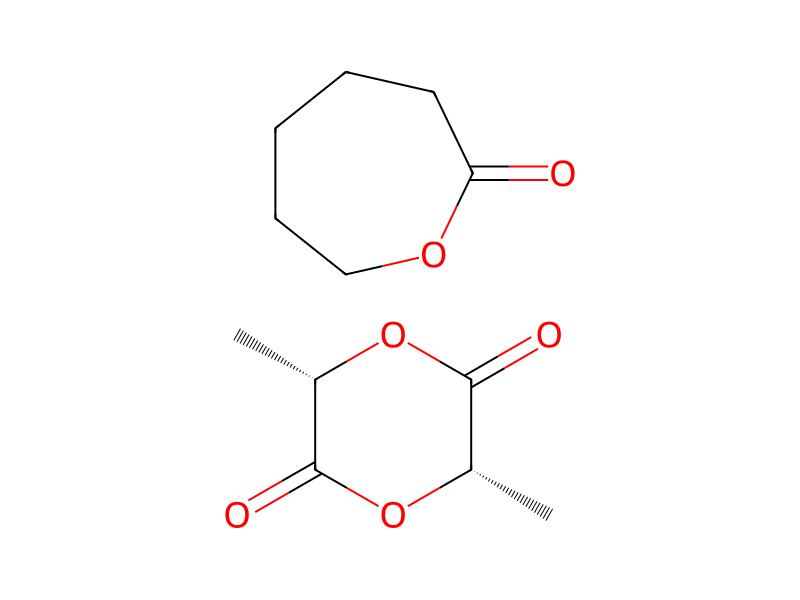
Triethanolamine → L-lactide epsilon-caprolactone
Reaction equation

[CH3:1][C@@H:2]1[O:9][C:7](=[O:8])[C@H:6]([CH3:10])[O:5][C:3]1=[O:4].[C:11]1(=[O:18])[O:17][CH2:16][CH2:15][CH2:14][CH2:13][CH2:12]1.N(CCO)(CCO)CCO>>[CH3:1][C@@H:2]1[O:9][C:7](=[O:8])[C@H:6]([CH3:10])[O:5][C:3]1=[O:4].[C:11]1(=[O:18])[O:17][CH2:16][CH2:15][CH2:14][CH2:13][CH2:12]1Participants
4

Conditions
- Temperature
- 140 °C
Procedure
The copolymer was prepared by copolymerizing a 74/26(molar) mixture of l-lactide and ε-caprolactone under dry nitrogen atmosphere in the presence of triethanolamine as initiator, monomer/initiator ratio of 2,220 and stannous octanoate as a catalyst at monomer/catalyst of 10,000. After melting the comonomers and mixing with the catalyst and initiator, the temperature was raised to 140° C. and reaction was continued for 60 hours. The polymer was isolated, ground and purified by distilling the residual monomer under reduced pressure. The purified polymer was characterized as described for P1 to P6 and pertinent analytical data are shown in Table III.
Workup
- customThe copolymer was prepared by copolymerizing
- additionmixing with the catalyst and initiator
- customreaction
- customThe polymer was isolated
- customground and purified
- distillationby distilling the residual monomer under reduced pressure
Sources & evidence
- ORD record
- ord-1fbfda4dc16c46faaab2ae525a03fd40
- Source dataset
- uspto-grants-2012_10
- Patent number
- US08298260B2
Reaction notes
Loading…