Allyl chloride → Propane, 2-bromo-1-chloro-
Reaction equation

[Br:1][CH2:2][CH2:3][CH2:4][Cl:5].[CH2:6]([Cl:9])[CH:7]=[CH2:8]>C1CCCCC1>[Br:1][CH2:2][CH2:3][CH2:4][Cl:5].[Br:1][CH:7]([CH3:8])[CH2:6][Cl:9]Participants
5
Reactant 2
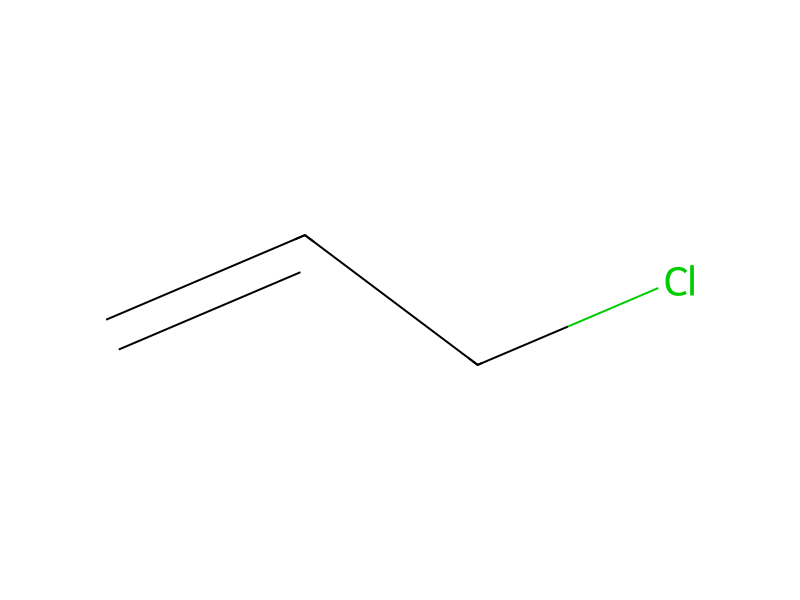

Product 2

Reagents, catalysts & solvents 1

Procedure
The same process as in example 2 was carried out, but the cyclohexane was replaced by 3-bromo-1-chloropropane. The reaction developed in the same way. After 30 minutes of irradiation at 22° C, 90% of allyl chloride had been converted. The reaction product was degassed and the unreacted allyl chloride was distilled. The remaining product was formed by 3-bromo-1-chloropropane (solvent + formed product) and about 3% of 2-bromo-1-chloropropane. This operation has the advantage of making the solvent distillation unnecessary.
Workup
- customAfter 30 minutes of irradiation at 22° C
- customThe reaction product was degassed
- distillationthe unreacted allyl chloride was distilled
Sources & evidence
- ORD record
- ord-fd729aa701f2427aaa34fce67080442c
- Source dataset
- uspto-grants-1977_09
- Patent number
- US04049516
Reaction notes
Loading…