H acid → 2-Aminobenzenesulfonic acid
Reaction equation

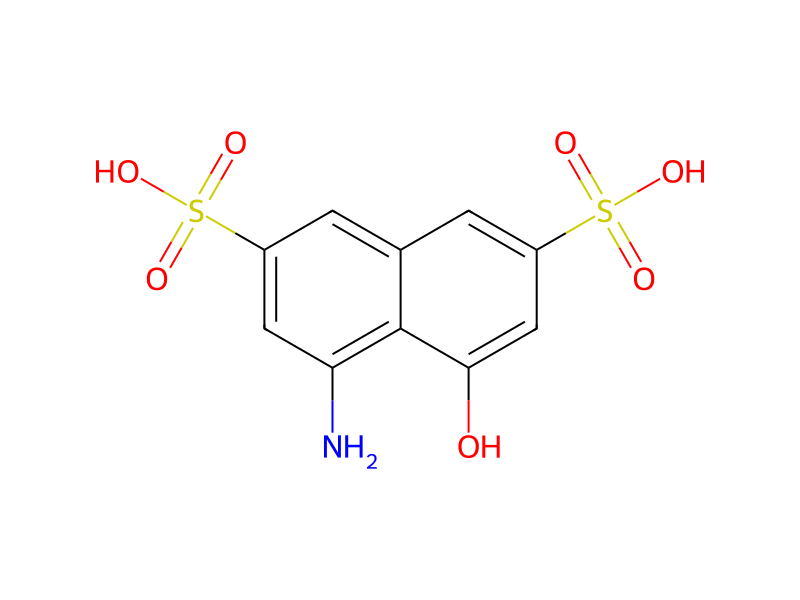
[NH2:1][C:2]1[CH:11]=[CH:10][C:9]2[C:4](=CC=CC=2CN)[C:3]=1[S:14]([OH:17])(=[O:16])=[O:15].OC1C2C(=CC(S(O)(=O)=O)=CC=2N)C=C(S(O)(=O)=O)C=1.C([O-])(=O)C.[Na+].[OH-].[Na+].C(=O)(O)[O-].[Na+]>>[S:14]([OH:17])(=[O:16])([C:3]1[C:2]([NH2:1])=[CH:11][CH:10]=[CH:9][CH:4]=1)=[O:15]Participants





Procedure
The diazotisation product prepared according to the instructions of Example 3 from 36.5 parts of 2-amino-1-sulpho-5-aminomethyl-naphthalene is mixed with a neutral solution of 46 parts of 1-hydroxy-8-amino-3,6-disulphonaphthalene. To accelerate the coupling, the mixture is buffered to pH 2 by adding sodium acetate solution. The acid coupling is complete after stirring for several hours. The dyestuff solution is neutralised with sodium hydroxide solution. 40 Parts of sodium bicarbonate and a little CaO are added and the diazotisation product obtained from 25 parts of o-sulphanilic acid is then added. The diazo dyestuff is separated out by adding salt. The paste is stirred into 1,000 parts by volume of water. 16 Parts by volume of 2,4,6-trifluoro-5-chloro-pyrimidine are added dropwise at 15° and pH 8.5. The pH is kept at 8.5 by simultaneous addition of 2 N sodium hydroxide solution. After completion of the acylation, the dyestuff is salted out, dried and ground. An easily water-soluble black dyestuff powder is obtained. In the form of the free acid, the dyestuff corresponds to the structure: ##STR22##
Workup
- customThe diazotisation product prepared
Sources & evidence
- ORD record
- ord-3d3a893844d44b6e8581209ed2e6ebf4
- Source dataset
- uspto-grants-1977_09
- Patent number
- US04049704
Reaction notes
Loading…