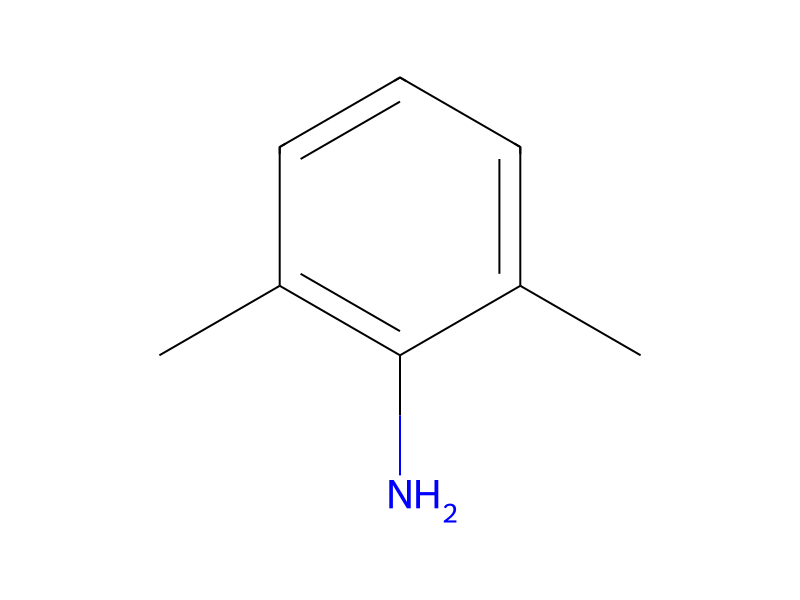
2,6-Dimethylaniline → 2,6-Dimethylaniline
Reaction equation

[CH3:1][C:2]1[CH:8]=[CH:7][CH:6]=[C:5]([CH3:9])[C:3]=1[NH2:4].[Br:10]C1C=C(C)C(N)=C(C)C=1>C(O)(=O)C>[CH3:1][C:2]1[CH:8]=[CH:7][CH:6]=[C:5]([CH3:9])[C:3]=1[NH2:4].[Br:10][C:8]1[C:2]([CH3:1])=[C:3]([C:5]([CH3:9])=[CH:6][CH:7]=1)[NH2:4]Participants
Reactant 2
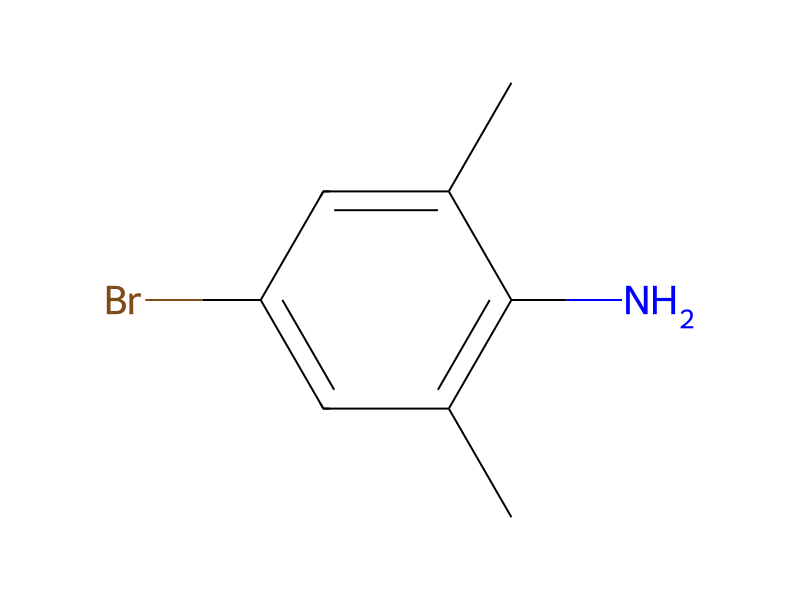
Product 2

Reagents, catalysts & solvents 1

Procedure
It is known that 4-bromo-2,6-dialkylanilines are predominantly formed by brominating 2,6-dialkylanilines. The high reactivity of these compounds causes the reaction to proceed non-selectively with the formation of different by-products, depending on the reaction conditions. Thus, for example, the bromination of 2,6-dimethylaniline in the presence of glacial acetic acid gives 4-bromo-2,6-dimethylaniline in a yield of 80-85% of theory (Chem. Ber. (1901), 34, 2242). The bromination of 2,6-dimethylaniline in strongly acid medium always results in the formation of substantial amounts of 3-bromo-2,6-dimethylaniline (Chem. Ber. (1900), 33, 1967). It is further known from published UK patent application A 2 098 210 that, in the halogenation of N-alkyl-2,6-dialkylanilines in the presence of a Lewis acid such as AlCl3, the halogen is even introduced selectively in 3-position.
Workup
- customare predominantly formed
- customthe reaction
- customdepending on the reaction conditions
Sources & evidence
- ORD record
- ord-b17c3bf1d3f6494d9d3e57c71cadc824
- Source dataset
- uspto-grants-1990_04
- Patent number
- US04918230
Reaction notes
Loading…