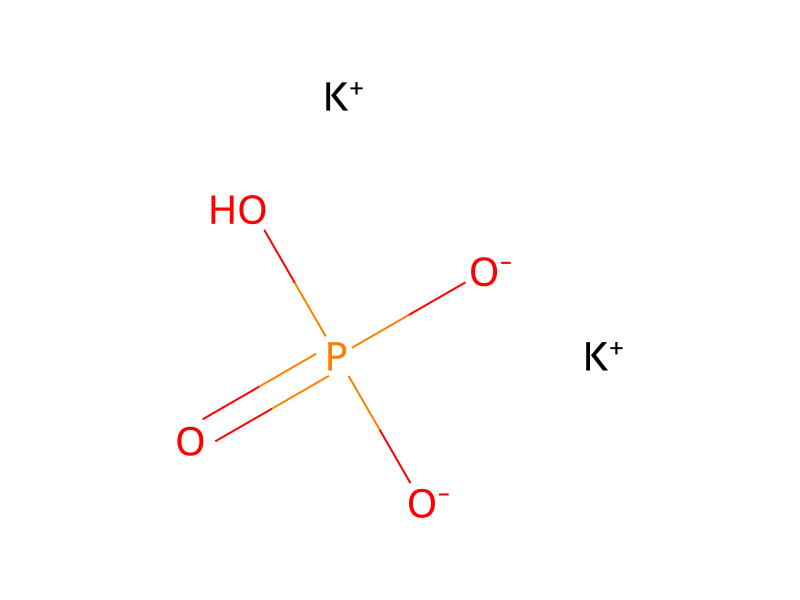
Potassium Phosphate, Dibasic → HCID 23689150, compound
Reaction equation

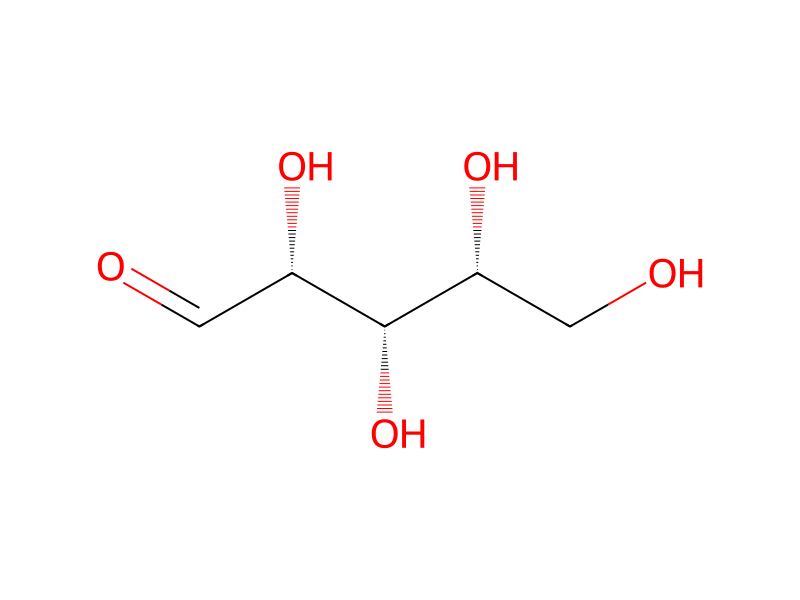
[O:1]=[CH:2][C@@H:3]([C@H:5]([C@@H:7]([CH2:9][OH:10])[OH:8])[OH:6])[OH:4].[O:11]=C[C@@H]([C@H]([C@H](CO)O)O)O.OP([O-])([O-])=O.[K+:26].[K+].OP([O-])(O)=O.[K+]>>[O:1]=[C:2]([O-:11])[C@@H:3]([C@H:5]([C@@H:7]([CH2:9][OH:10])[OH:8])[OH:6])[OH:4].[K+:26]Participants



Conditions
- Temperature
- 30 °C
Procedure
For microbial oxidation of D-xylose or L-arabinose, fermentation medium (1 L) contains K2HPO4 (2 g), KH2PO4 (1 g), (NH4)2SO4 (5 g) and yeast extract (5 g). Solutions of D-xylose (100 g) or L-arabinose (100 g) and MgSO4 (0.24 g) are autoclaved separately and added immediately prior to initiation of the fermentation. Inoculants are started by introduction of a Pseudomonas fragi single colony picked from a nutrient agar plate into 5 mL of fermentation medium. Cultures are grown at 30° C. with agitation at 250 rpm until they are turbid (˜24 h) and subsequently transferred to 100 mL of fermentation medium. Cultures are grown at 30° C. and 250 rpm for an additional 12 h. The inoculant (OD600=1.0-3.0) is then transferred into the fermentation vessel and the batch fermentation is initiated (t=0 h). The fermentation control settings are: 30° C., stirring speed at 650 rpm, and airflow at 0.5 L/L/min. The culture medium is maintained at pH 6.4 by addition of 2 N H2SO4 and a base solution, which is 30% CaCO3 for oxidation of D-xylose or concentrated NH4OH for oxidation of L-arabinose. A standard curve is determined for each metabolite using solutions of authentic, chemically synthesized samples. (Moore, S.; Link, K. P. J. Biol. Chem. 1940, 133, 293.) Compounds are quantified by 1H NMR using the following resonances: D-xylonic acid (δ4.08, d, 1H); L-arabinonic acid (δ4.24, d, 1H); and L-arabino-1,4-lactone (δ4.64, d, 1H). A modified procedure by Buchert is employed for the purification of D-xylonate. Following treatment with activated carbon and concentration (1-1.1 L to 250 mL) of D-xylonate containing fermentation broth, EtOH (3:1, v/v) is added. After 12 h at 4° C., the precipitated calcium xylonate is filtered and dried under vacuum (95% recovery based on D-xylonate in the crude fermentation broth). Potassium D-xylonate is obtained by passing an aqueous solution of calcium xylonate through a Dowex 50 (K+ form) column (Applied Membranes, Vista, Calif., USA).
Workup
- extractionextract (5 g)
- additionadded immediately
- customare grown at 30° C. with agitation at 250 rpm until they
- customturbid (˜24 h)
- customare grown at 30° C.
- custom(t=0 h)
- temperatureThe culture medium is maintained at pH 6.4 by addition of 2 N H2SO4
- customA modified procedure by Buchert is employed for the purification of D-xylonate
- concentrationwith activated carbon and concentration (1-1.1 L to 250 mL) of D-xylonate containing fermentation broth, EtOH (3:1, v/v)
- additionis added
- waitAfter 12 h at 4° C.
- filtrationthe precipitated calcium xylonate is filtered
- customdried under vacuum (95% recovery
Sources & evidence
- ORD record
- ord-c444edcb97ac4b0892a8aca3a8fbdc92
- Source dataset
- uspto-grants-2011_04
- Patent number
- US07923226B2
Reaction notes
Loading…