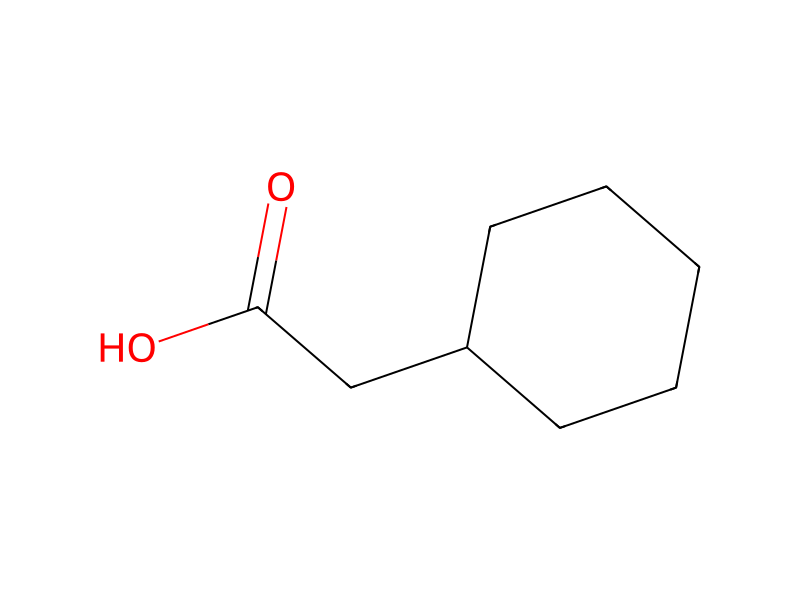
Methanol → Cyclohexaneacetic acid
Reaction equation

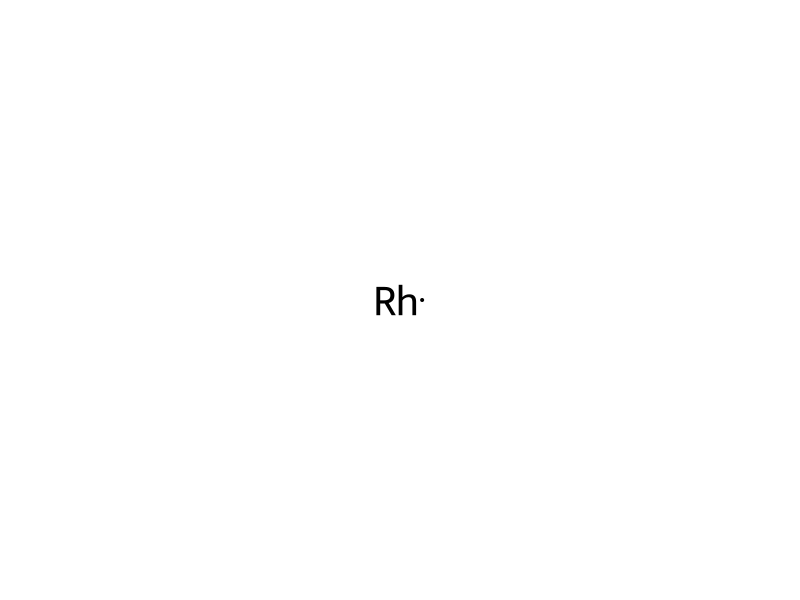
CO.[C:3]1([CH2:9][C:10]([OH:12])=[O:11])[CH:8]=[CH:7][CH:6]=[CH:5][CH:4]=1>[Rh].C(O)(=O)C>[CH:3]1([CH2:9][C:10]([OH:12])=[O:11])[CH2:8][CH2:7][CH2:6][CH2:5][CH2:4]1Participants
Reactant 2


Product 1
Reagents, catalysts & solvents 2

Procedure
1,4-Benzodioxepin-3-cyclohexyl-2,5-dione. To a solution of 200 mL methanol were added 27.2 g phenylacetic acid, 2.5 mL acetic acid, and 7.5 g rhodium on alumina (5%, Engelhard 5864). The mixture was sealed in an autoclave, purged with nitrogen, and then filled with hydrogen gas. Hydrogenation was carried out at room temperature for 8 hours under 1400 psi. The reaction mixture was then removed from the autoclave and filtered. The filtrate was concentrated to give 28.0 g (98%) crude 2-cyclohexylacetic acid. The crude acid was used directly without further purification. To a 500 mL 3-neck flask were added 85.7 g (0.6 mol) of 2-cyclohexylacetic acid, 86 mL thionyl chloride (1.2 mol), and a magnetic stir bar. The solution was stirred first at room temperature for 1 hour, and then at 85° C. for 1 hour. 38 mL bromine (0.75 mol) was added dropwise over 30 minutes, and the solution was stirred overnight at 85° C. The solution was vacuum distilled to give 2-cyclohexyl-2-bromoacetyl chloride as a bright pale yellow liquid. To a 500 mL 3-neck flask were added 27.6 g (0.2 mol) of salicylic acid, 55.1 g (0.23 mol) of 2-cyclohexyl-2-bromoacetyl chloride, and 300 mL THF. The flask was purged with nitrogen and then cooled in a NaCl salt-ice bath. A mixture of 34.8 mL triethyl amine and 50 mL THF was added dropwise under mechanical stirring and the solution was cooled and stirred overnight. The solution was filtered to remove a white solid, and the filtrate was evaporated to dryness. The solid was dissolved in ethyl acetate. The solution was washed with 2 M HCl (3×100 mL), saturated NaCl, dried over MgSO4, and then concentrated to give a pale yellow crystal of the crude linear acid ester. 17.1 g of the acid ester intermediate was mixed with 400 mL THF and 10.5 mL (0.075 mol) triethyl amine, and refluxed overnight. The solids were removed by filtration and the THF was evaporated to dryness. The crude product was dissolved in ethyl acetate, washed with 2 M HCl (3×100 mL), saturated NaCl, dried over MgSO4, and the ethyl acetate was removed by rotary evaporation. The crude product was recrystallized from toluene twice, and the needle-like colorless crystals were collected by filtration and dried under vacuum to give 5.85 g (45%) of 1,4-benzodioxepin-3-cyclohexyl-2,5-dione. 1H NMR (CDCl3): δ (ppm) 7.94 (d, J=7.8 Hz, 1H), 7.68 (t, J=7.9 Hz, 1H), 7.41 (t, J=7.6 Hz, 1H), 7.25 (d, J=8.3 Hz, 1H), 4.40 (d, J=7.6 Hz, 1H), 2.24-2.08 (m, 2H), 1.88-1.65 (m, 4H), 1.42-1.25 (m, 2H), 1.24-0.99 (m, 3H). 13C NMR (CDCl3): δ (ppm) 166.03, 164.11, 149.82, 135.48, 132.56, 126.55, 120.72, 120.11, 76.53, 37.70, 28.90, 27.28, 26.07, 25.51, 25.33. IR (KBr): ν (cm−1) 3074, 2954, 2933, 2851, 1783, 1729, 1606, 1453, 1297, 1247, 1212, 1133. Anal. Calcd. for C15H16O4: C, 69.22; H, 6.20. Found: C, 69.28; H, 6.17. MS (EI) m/z 260.1 (0.3), 232.1 (2.9), 149.0 (10), 120.0 (100), 92.0 (33). mp 156-157° C.
Workup
- customThe mixture was sealed in an autoclave
- custompurged with nitrogen
- additionfilled with hydrogen gas
- customThe reaction mixture was then removed from the autoclave
- filtrationfiltered
- concentrationThe filtrate was concentrated
Sources & evidence
- ORD record
- ord-c556c871bb4442b4859b51c7e296ac70
- Source dataset
- uspto-grants-2011_04
- Patent number
- US07923528B2
Reaction notes
Loading…