Acetonitrile → 4-(3-Hydroxypropoxy)benzonitrile
Reaction equation

[OH:1][C:2]1[CH:9]=[CH:8][C:5]([C:6]#[N:7])=[CH:4][CH:3]=1.C(=O)([O-])[O-].[K+].[K+].C(#N)C.Br[CH2:20][CH2:21][CH2:22][OH:23]>O.C1(C)C=CC=CC=1>[OH:23][CH2:22][CH2:21][CH2:20][O:1][C:2]1[CH:9]=[CH:8][C:5]([C:6]#[N:7])=[CH:4][CH:3]=1Participants
7
Reactant 4



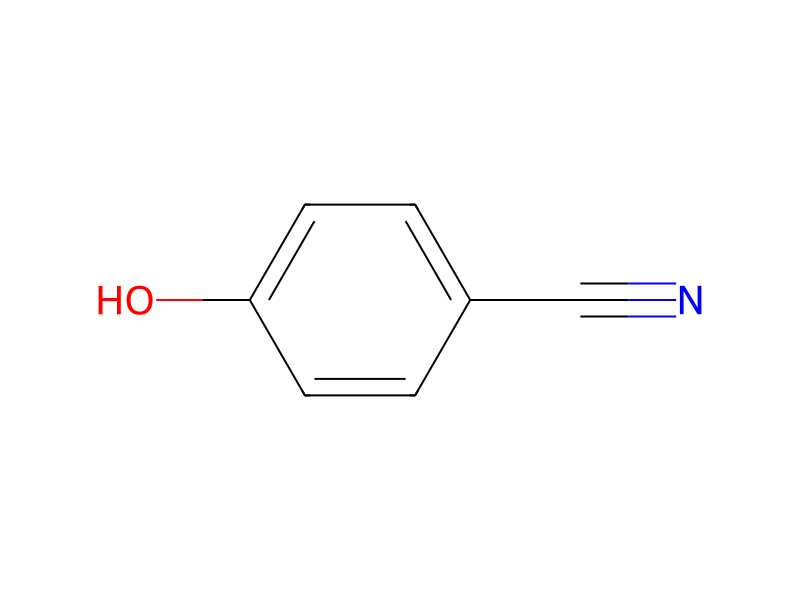
Product 1

Reagents, catalysts & solvents 2


Conditions
- Temperature
- 84 °C
Procedure
To a flask was added 4-hydroxybenzonitrile (10 g, 82.7 mmol, 1 eq.) and potassium carbonate (13.60 g, 98.7 mmol, 1.25 eq.). To this mixture was added acetonitrile (80 mL) and then, under stirring, 3-bromo-1-propanol (12.25 g, 86.40 mmol, 1.05 eq.). The reaction mixture was heated at reflux (84° C.) for 5 hours before being allowed to cool to room temperature. Toluene (80 mL) and water (50 mL) were added and the resulting mixture was heated (≈30° C.) until all of the solids had gone into solution. The aqueous layer was separated from the organic layer. The organic layer was retained.
Workup
- temperatureThe reaction mixture was heated
- temperatureto cool to room temperature
- temperaturethe resulting mixture was heated (≈30° C.) until all of the solids
- customThe aqueous layer was separated from the organic layer
Sources & evidence
- ORD record
- ord-45690dad38b44a66bfd5cecb4731050a
- Source dataset
- uspto-grants-2011_04
- Patent number
- US07928225B2
Reaction notes
Loading…